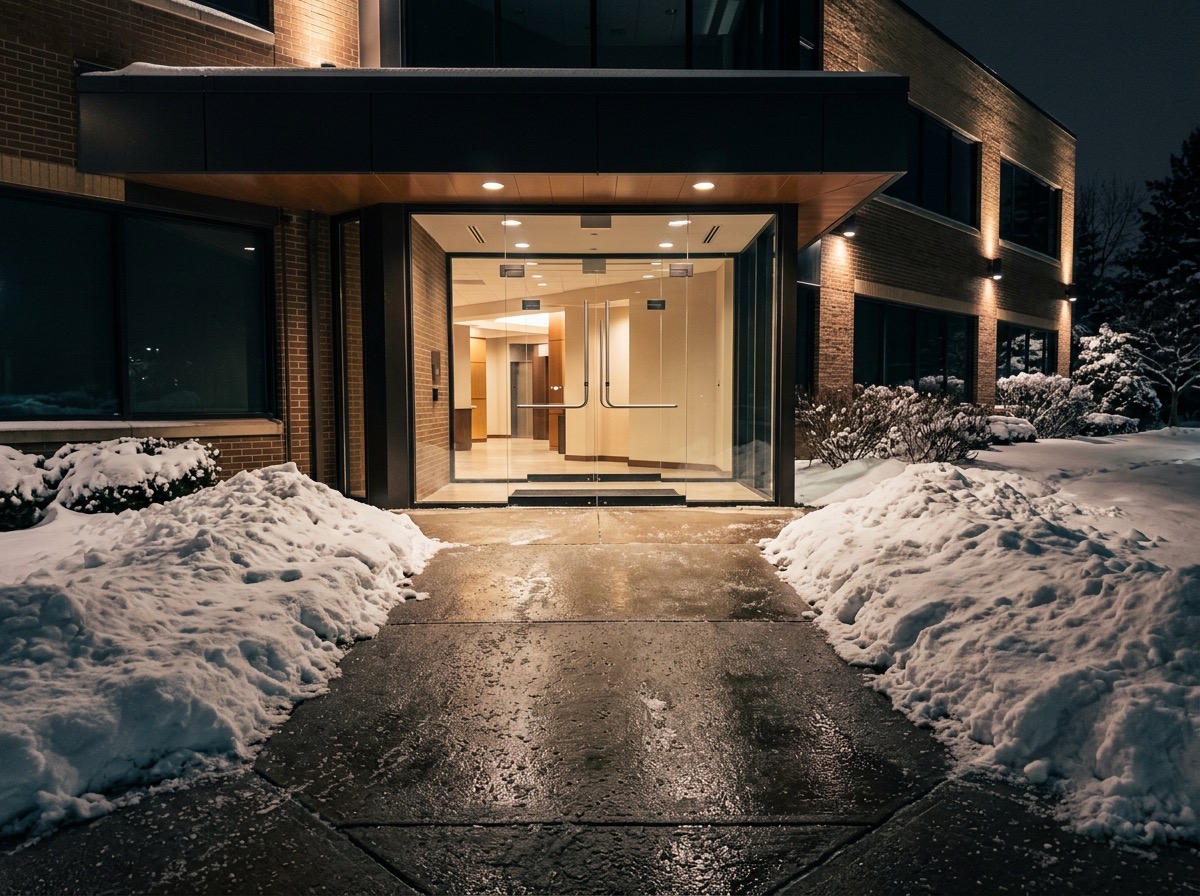
In Ontario, anyone hurt by snow or ice on private property must serve written notice on the occupier or snow contractor within 60 days, and whoever receives it must pass a copy on by registered mail or in person. Dated logs, photos and salt records let you answer weeks or years later.
Key takeaways
Last updated: November 2026
Ontario's 60-day snow and ice notice rule means that anyone hurt in a slip or fall on snow or ice on your property must give you, or your snow contractor, written notice within 60 days before they can sue. The notice has to state the date, time and location of the incident, and it applies to falls on or after January 29, 2021, under the Occupiers' Liability Act as amended in 2020.
For plaza owners, condo boards, church committees and property managers in Midland and Penetanguishene, that rule is helpful, but only if your records can answer the notice when it arrives. A letter can land six or seven weeks after a storm you barely remember. We build landscapes and clear commercial lots across southern Georgian Bay, and this guide explains the rule in plain language, what it does not change, and the practical steps that keep you ready. This is general information, not legal advice. Talk to a lawyer or your insurer about your own situation.
Key Takeaways
- An injured person must serve written notice within 60 days of a snow or ice fall before suing the occupier or the snow contractor.
- The notice must state the date, time and location of the incident and be served personally or by registered mail.
- Notice is not required if the person died, and a judge can waive it for a reasonable excuse if the defence is not prejudiced.
- The rule does not shorten the two-year limitation period. A lawsuit can still follow up to two years later.
- Your best protection is a written contract, dated service logs, timestamped photos, salt records and a clear incident procedure.
- If you receive a notice, the Act says you must serve a copy on any other occupier and on your snow contractor, in person or by registered mail. Tell your insurer the same day.
What does Ontario's 60-day snow and ice notice rule actually say?
The rule came from Bill 118, the Occupiers' Liability Amendment Act, 2020. It received Royal Assent on December 8, 2020 and came into force on January 29, 2021, as summarized by Borden Ladner Gervais. It added a new notice step to the Occupiers' Liability Act for one specific kind of claim: personal injury caused by snow or ice.
In short, no lawsuit for that kind of injury can go ahead against an occupier, or against the independent contractor hired to remove snow or ice, unless written notice was served within 60 days of the incident. Before 2021, an injured person could simply file a claim within the general two-year window, and the first a business heard of it might be a statement of claim almost two years after the fall. By then the snow was long gone, staff had moved on, and nobody could say whether the walkway had been salted that morning.
The 60-day rule is an early warning. It does not decide who is at fault. It makes sure you hear about a claim while the winter is still fresh enough to investigate.
Who does the rule cover?
The rule covers two groups.
- Occupiers. Under Ontario law, an occupier is the person or business with physical possession of a property or responsibility and control over its condition. That can be an owner, a tenant who controls a space, a condo corporation or a property manager acting for the owner. A single plaza on King Street in Midland can have several occupiers at once.
- Snow contractors. The rule also covers the independent contractor employed by the occupier to remove snow or ice at the time of the incident. Your plow and salt provider is inside the rule, not outside it.
Notice served on any one occupier or contractor keeps the claim alive against all of them, under section 6.1(7) of the Act. Whoever receives it then has a legal duty to pass it on. An occupier that gets a notice must serve a copy on every other occupier of the property and on the snow contractor working there at the time. A contractor that gets one must serve a copy on the occupier that hired it. The copy has to go in person or by registered mail, the same way the original did. An email to your plow company does not meet the Act's wording.
What the Act does not set is a deadline for forwarding, as LAWPRO's practicePRO points out. Your snow contract should set one, such as two business days, and name the address where each side accepts registered mail.
The rule covers any "personal injury caused by snow or ice", which is wider than a slip on a walkway. Snow or ice sliding off a roof, an awning or a sign onto a customer falls under the same wording. A trip on a broken curb or a heaved paver in July is a different matter and follows the ordinary rules.
What must the notice include, and how is it served?
The notice must be in writing. It must set out the date, time and location of the incident, as explained by Miller Thomson. It must be served personally or sent by registered mail to the occupier, the contractor, or both.
Do not count on a sloppy notice being thrown out. Section 6.1(6) lets a judge accept an incomplete notice, as well as a late one, if there is a reasonable excuse and your defence is not prejudiced. If anything arrives that mentions a fall, an injury and a date, treat it as a notice and act on it the same day.
What to do the day a notice arrives
- Write down when and how it arrived, and keep the envelope.
- Send a copy to your insurer or broker.
- Serve a copy on your snow contractor and any other occupier (landlord, tenant or property manager) in person or by registered mail, and keep the receipt. Ask the contractor for their service log, photos and salt record for that date.
- Pull your own records for the same date: incident reports, staff notes, security footage and any tenant complaints.
- Do not argue with the injured person or admit fault in writing. Let your insurer or lawyer guide the reply.
Are there exceptions to the 60-day rule?
Yes, two. First, notice is not required if the injured person died as a result of the injury. Second, a missing, late or incomplete notice does not end the claim if a judge finds the person had a reasonable excuse and the defendant was not prejudiced. A person who spent the 60 days in hospital is the kind of situation that could qualify.
The wording copies the 10-day notice rule for claims against municipalities, and Ontario's Court of Appeal has read "reasonable excuse" broadly in those cases, for example in Azzeh v. Legendre, 2017 ONCA 385, as practicePRO notes. Expect courts to be just as flexible here.
Courts decide what counts as a reasonable excuse case by case. That uncertainty is one more reason not to rely on the deadline alone. Assume a claim can reach you late and keep your records as if it will.
What if someone falls on the Town sidewalk in front of my business?
Then a different rule applies. The Occupiers' Liability Act does not cover a municipality as occupier of a public road, under section 10(2). A fall on a Town sidewalk is a claim against the Town under section 44 of the Municipal Act, 2001, which needs written notice to the municipal clerk within 10 days, not 60. The same section says a municipality is not liable for snow or ice on a sidewalk except in a case of gross negligence.
For a storefront on King Street in Midland or Main Street in Penetanguishene, the line between your private walkway and the Town sidewalk can be a few steps. Mark that line on your snow contractor's site map, and make sure your logs and photos show your own entrance, steps and walkway clearly. If a claim names both you and the Town, those records show which part was yours.
Does the 60-day notice replace the two-year limitation period?
No. This is the point most owners miss. The 60-day notice is an added first step. It does not change the general two-year limitation period for starting a lawsuit, as both RENX and the law firms above point out.
So a fall in January 2027 could produce a notice in March 2027 and a statement of claim in late 2028. If your service records for that January morning were tossed in the spring cleanup, you have very little to defend with.
Children stretch that window further. Under section 6 of the Limitations Act, 2002, the two-year clock does not run while the injured person is a minor and has no litigation guardian. A child who falls in a church or arena parking lot could sue years later. The 60-day notice still applies, but your records may need to last far longer than two winters. Ask your lawyer or insurer for a retention period in writing.
What should Midland and Penetang property owners do now?
The rule rewards owners who can show what happened on a given morning. Here is the practical setup we suggest before the first big storm.
1. Put the snow contract in writing
A handshake deal with a neighbour who has a plow is common around Georgian Bay. It is also hard to defend. A written contract should name the trigger depth for plowing, the salting or sanding trigger (for example, any freezing rain), the service hours and priority order, which walkways and entrances are included, where snow piles go, how damage is reported, and proof of insurance. It should also say that either party will forward any slip-and-fall notice to the other within a set number of days. Our guide to choosing a commercial snow removal contractor in Midland walks through each clause.
2. Ask for dated service logs
Every visit should be recorded with the date, arrival and departure times, the work done (plow, shovel, salt, sand) and who did it. Ask your contractor how they log visits and how quickly you can get a copy. If you are comparing quotes, a contractor with clean records is worth more than a slightly lower price. Our guide to commercial snow removal costs in Midland and Penetanguishene covers what drives the price.
3. Take timestamped photos
Photos of the main entrance, accessible parking, ramps and the busiest walkway after each service visit are cheap insurance. A phone camera stores the time and often the location. Agree on who takes them: your contractor, your site staff, or both.
4. Keep salt and sand records
Write down when material went down, roughly how much, and where. Freeze-thaw cycles off Midland Bay and Penetang Bay can turn a clear lot into glare ice overnight, so a record showing a re-salt at 6 a.m. matters.
5. Set an incident procedure
Give staff a one-page form: who fell, where, when, what the surface looked like, the weather, and any witnesses. Take photos of the spot right away. Store the form with your snow logs for that date.
6. Pass notices on fast
Make it a rule that any notice is served on your contractor, by registered mail or in person, and reported to your insurer within a day or two. The Act sets the method but no deadline, so your contract has to supply one.
How does good snow management lower the risk in the first place?
Paperwork answers a claim. Good site planning prevents one. Most slip-and-fall risk on a commercial lot comes from the same few places: meltwater that refreezes below snow piles, shaded entrances on the north side of a building, ramps and steps, and the stretch of walkway between accessible parking and the door.
That is where a landscaper's eye helps. We design and build walls, steps, patios and grading for a living, so we look at where water runs before we decide where snow goes. A pile placed uphill of an entrance melts across the walkway every sunny afternoon and freezes again at dusk. The same pile placed downhill, away from doors and drains, causes far fewer problems. Our snow and ice management planning starts with that kind of site map.
Local rules matter too. Midland's new Snow Removal By-law limits where snow can be piled, and Penetanguishene bans pushing snow onto Town roads. We cover both in Midland snow rules for businesses and property managers and our Penetanguishene winter guide.
What does this look like for local properties?
A few common situations across North Simcoe:
- Retail plazas on King Street or Highway 93. Several tenants often share one lot. Make sure the lease says who the occupier is for snow and who holds the contract, so a notice is not stuck in a tenant's inbox.
- Medical and dental offices. Patients with walkers and canes arrive early. Your contract should put entrances, ramps and accessible spaces first in the priority order.
- Churches. Sunday morning and weekday funerals are the high-risk times. Agree on when the lot must be ready, and log it.
- Condo buildings in Midland and Penetang. Boards should confirm the contract covers walkways and stairs, not just the driveway, and that logs are shared with the property manager. See our condo snow removal contracts page.
- Industrial yards in Tay and Tiny townships. Loading docks and shift changes create early-morning foot traffic that a daytime-only schedule misses.
Plan your snow contract before the first storm
The 60-day rule gives you a fair chance to answer a claim, but only if the records exist. The simplest time to set that up is before the first squall rolls off Georgian Bay. We start every commercial snow job with a pre-season site walk and a written proposal that shows where snow will be stored, what gets cleared first, and how service is recorded.
Book a pre-season site walk and snow removal quote, or read more about our commercial snow removal service for Midland, Penetanguishene and the surrounding townships. Again, this article is general information, not legal advice. For advice on a specific claim or contract, speak with a lawyer or your insurer.
Plan your snow contract before the first squall.
We walk your site, map where the snow goes and send a written proposal. Plazas, offices, condos, churches and industrial yards.
Forty-Five Scapes did an amazing job on my property. I started with such a mess, mud and weeds and poor grading. I met with Mark and he put my mind at ease. He took my wants and needs and budget and created a vision. The crew was always on time and respectful and the end product was amazing. I look forward to many years with my amazing outdoor space.
Frequently asked questions
Since January 29, 2021, anyone injured by snow or ice on private property in Ontario must serve written notice within 60 days before suing the occupier or the snow contractor. The notice must give the date, time and location, and go in person or by registered mail. A judge can excuse a late or incomplete notice if there is a reasonable excuse and no prejudice, and no notice is needed if the person died.
The Occupiers' Liability Act requires an occupier to serve a copy on every other occupier and on the snow contractor working there at the time. A contractor must serve a copy on the occupier that hired it. Copies go in person or by registered mail, not email. The Act sets no deadline, so do it within a day or two and tell your insurer the same day.
No. Falls on a municipal road or sidewalk fall under section 44 of the Municipal Act, 2001, which needs written notice to the municipal clerk within 10 days. Municipalities are also only liable for snow or ice on sidewalks in cases of gross negligence. That is why your site map should show exactly where your private walkway ends and the Town sidewalk begins.
At least past the two-year limitation period, and often longer. The two-year clock does not run while an injured person is a minor without a litigation guardian, so a child's fall could lead to a claim years later. Keep the contract, service logs, photos, salt records and incident reports together. This is general information, not legal advice, so get a retention period from your lawyer or insurer.