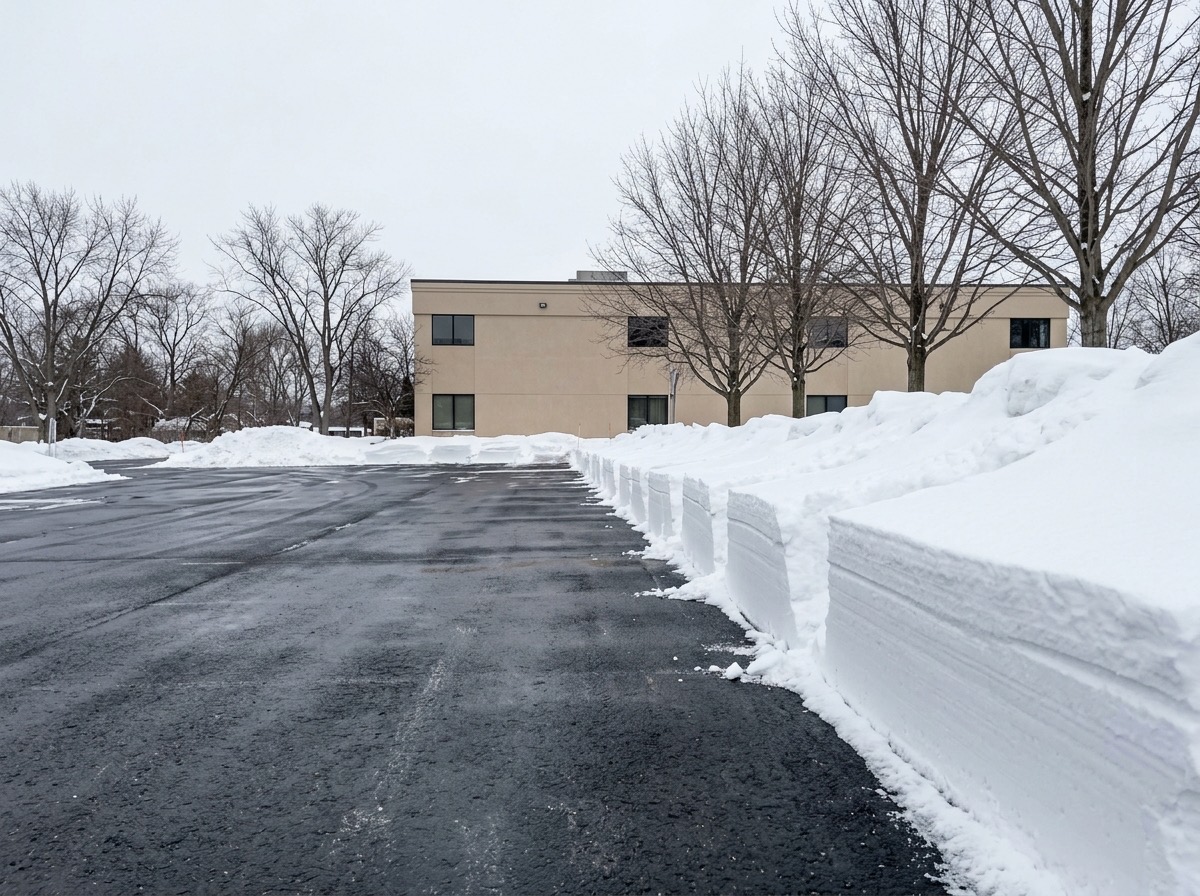
Midland's By-law 2025-53 bans snow on roads, sidewalks, Town property, boulevards, hydrants, drains, accessible spaces and fire routes, with $300 to $500 set fines. Overnight street parking is banned midnight to 7 a.m., Nov 15 to Apr 1, so plan plowing and storage around both.
Key takeaways
Last updated: November 2026
Midland's snow removal bylaw, By-law 2025-53, says you cannot put snow from your property onto a road, sidewalk, someone else's land, a fire hydrant, an accessible parking space or a fire route, and you cannot pile it where it blocks a driver's view. On top of that, the Town's winter parking rule bans overnight parking on Town streets and in municipal lots from midnight to 7 a.m., November 15 to April 1.
For plaza owners, landlords, condo boards and property managers, those two rules shape almost every snow decision: when the plow comes, where the snow goes, and what happens when the lot fills up in February. The by-law was enacted on October 15, 2025, replacing the old 2009-69 rules, so this is the second winter it applies. We are a design-build landscaper that also clears commercial lots, and this guide explains what the rules mean on the ground. Always confirm current-season dates and details with the Town of Midland.
Key Takeaways
- Midland's overnight parking ban runs midnight to 7 a.m., November 15 to April 1, on Town streets and municipal lots, in any weather.
- By-law 2025-53 bans putting snow or ice on a road, roadway or sidewalk, or on any property you do not own or lawfully occupy.
- No snow on or beside fire hydrants, in accessible parking spaces or fire routes, or anywhere it blocks Town drains.
- Most offences carry a $300 set fine, and $500 for snow in an accessible space or fire route. After one notice in a calendar year, the Town can clean up repeat problems without warning and bill the property.
- The rule covers anyone who "permits or aids" the depositing, so your snow contractor and you can both be responsible.
- A site map that marks snow storage areas before the first storm is the simplest way to stay inside the rules.
What does Midland's overnight winter parking ban mean for businesses?
According to the Town of Midland's winter parking page, parking on Town streets and in municipal parking lots is not allowed from midnight to 7 a.m. between November 15 and April 1. The ban applies whether or not it is snowing, and vehicles can be ticketed or towed. The Town's page now cites Parking By-law 2026-24. Dates can change, so check the page each fall.
There is a second, stricter rule. When the Town declares a Significant Weather Event for heavy snow, high winds or ice, nobody may park on Town streets at any time until it ends, day or night. Watch the Town's alerts in a big storm and warn tenants who rely on street parking during the day.
For a private business, the ban matters in three ways.
- Tenant and resident parking. Apartment and mixed-use buildings downtown often have tenants who park on the street overnight. From mid-November, those cars need somewhere legal to go, which usually means your private lot. A lot that is full of parked cars at 3 a.m. is hard to plow well.
- Lots next to municipal parking. Many King Street and Hugel Avenue businesses back onto or share a property line with a Town lot. The Town clears its own lot. Your contractor must not push your snow onto it, and the Town's crews may be working next door at the same hours.
- Overnight plow windows. Once the street is empty, it is easier for plows to enter and leave your site. Many commercial contracts schedule the main clearing in the early morning so lots are clear before staff and customers arrive.
If you manage a residential or mixed-use property, tell tenants in writing where they can park overnight in winter, and mark those spaces on the snow contractor's site map. Cars that never move are the main reason snow gets pushed somewhere it should not go.
What does Snow Removal By-law 2025-53 actually prohibit?
The full text of By-law 2025-53 is short and worth reading. Its general provisions say no person shall deposit, or permit or aid in depositing, snow or ice:
- on a highway, roadway or sidewalk (section 2.1);
- on a boulevard that is not adjacent to their own property (2.2);
- on a boulevard in a way that obstructs a motorist's line of sight (2.3);
- onto any property they do not own or lawfully occupy, including Town property and private property owned by someone else (2.4);
- on, or immediately adjacent to, a fire hydrant, or in any way that obstructs access to one (2.5);
- in a way that obstructs drainage to any Town drain or sewer (2.6).
It also bans piling snow on a sidewalk, boulevard or roadway in a way that obstructs traffic, blocks the view of traffic, or gets in the way of Town, County or provincial plows (2.7), and bans piling snow in an accessible parking space or fire route on private or municipal property (2.8).
The by-law defines "deposit" broadly. It includes dumping, throwing, piling, redistributing, placing or storing snow, even temporarily. So a pile left on the sidewalk "just until the loader comes back" still counts.
Can I put snow on the boulevard in front of my business?
Be careful here. Section 2.2 only bans snow on a boulevard that is not next to your property, which suggests your own frontage is fine. But section 2.4 bans snow on any Town property, and the by-law defines Municipal Property to include boulevards. It also defines the boulevard as the strip between the Town property line and the curb, so most of that grass in front of a King Street shop belongs to the Town.
Read together, the safe approach is to shovel walkway snow onto your own frontage in small amounts, kept low and clear of sightlines, and never to use the boulevard as a storage area for lot snow. If your plan depends on the boulevard, ask the Town's by-law office before the season, not after a ticket.
Who is responsible: the owner or the plow contractor?
Both can be. The wording "permit or aid in the depositing" reaches the person who hired the work as well as the person driving the plow. An officer can also issue a notice or order to whoever caused the problem or to the owner of the land.
Here is what that costs, from the set fine schedule at the back of the by-law:
- $300 for snow on a road, sidewalk, the wrong boulevard, Town property, a neighbour's land, a hydrant or a drain, or for a pile that blocks traffic, sightlines or Town plows.
- $500 for snow in an accessible parking space or fire route, on private or Town property.
- $300 or $500 for ignoring a notice or an order.
Two other clauses matter more for a busy lot. Under section 4.7, the Town only has to give one notice per calendar year. After that, a repeat problem can be cleaned up without further warning, and the cost is treated like property taxes and added to the tax roll. If the bill is over $1,000, the Town can place a lien on the property (section 6.4). Court fines can go much higher, up to $100,000, with each day counted as a separate offence.
The practical answer is to make your contractor's obligations clear in writing, and to check the site yourself after the first few storms.
Why can't I just push snow onto the road?
Because it is banned at two levels. Section 2.1 of By-law 2025-53 prohibits it, and the by-law's preamble points to section 181 of Ontario's Highway Traffic Act, which says no person shall deposit snow or ice on a roadway without written permission from the road authority.
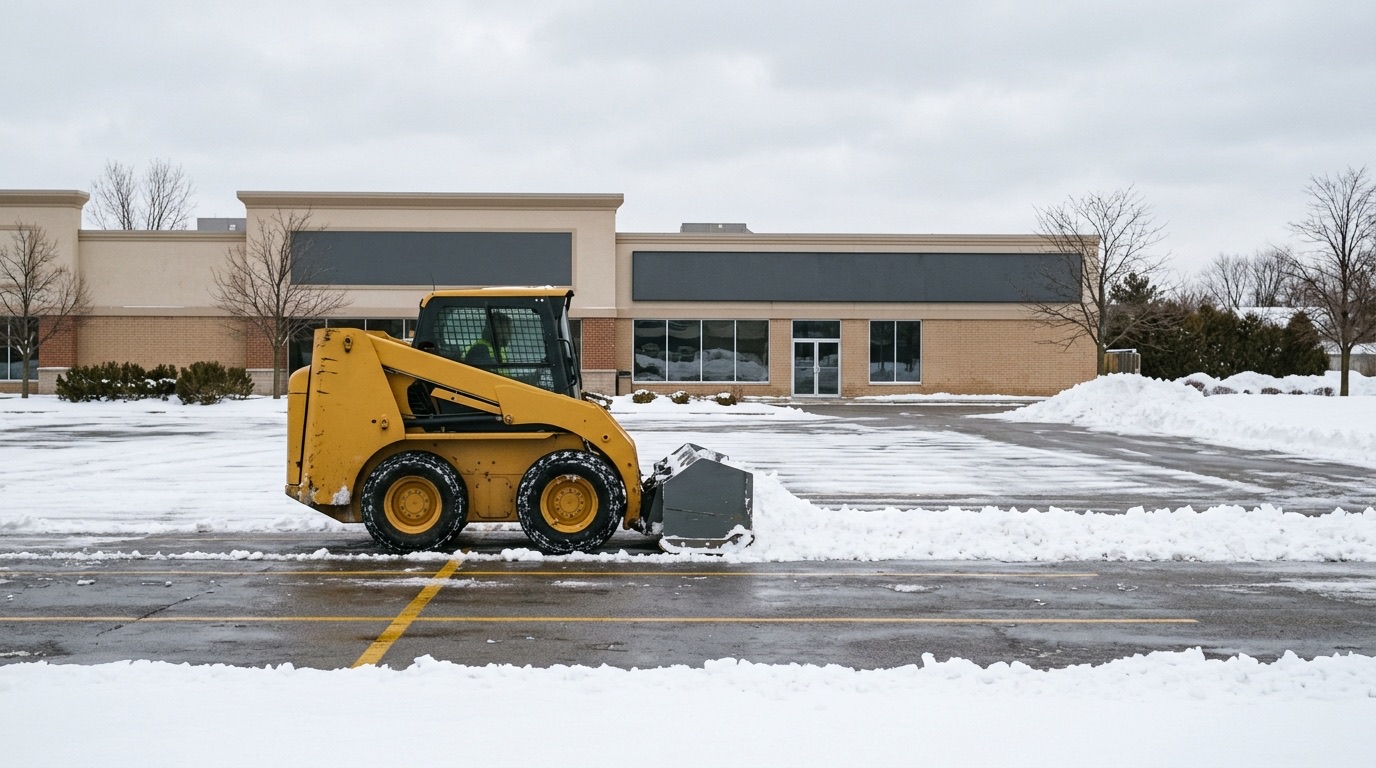
The by-law does not apply to Town, County or provincial plows (section 3.1), and the Town does not clear windrows. So the ridge a Town plow leaves across your entrance is yours to deal with, and the only legal place for it is back on your own property. Ask your contractor whether a return visit after the Town plow passes is in the price.
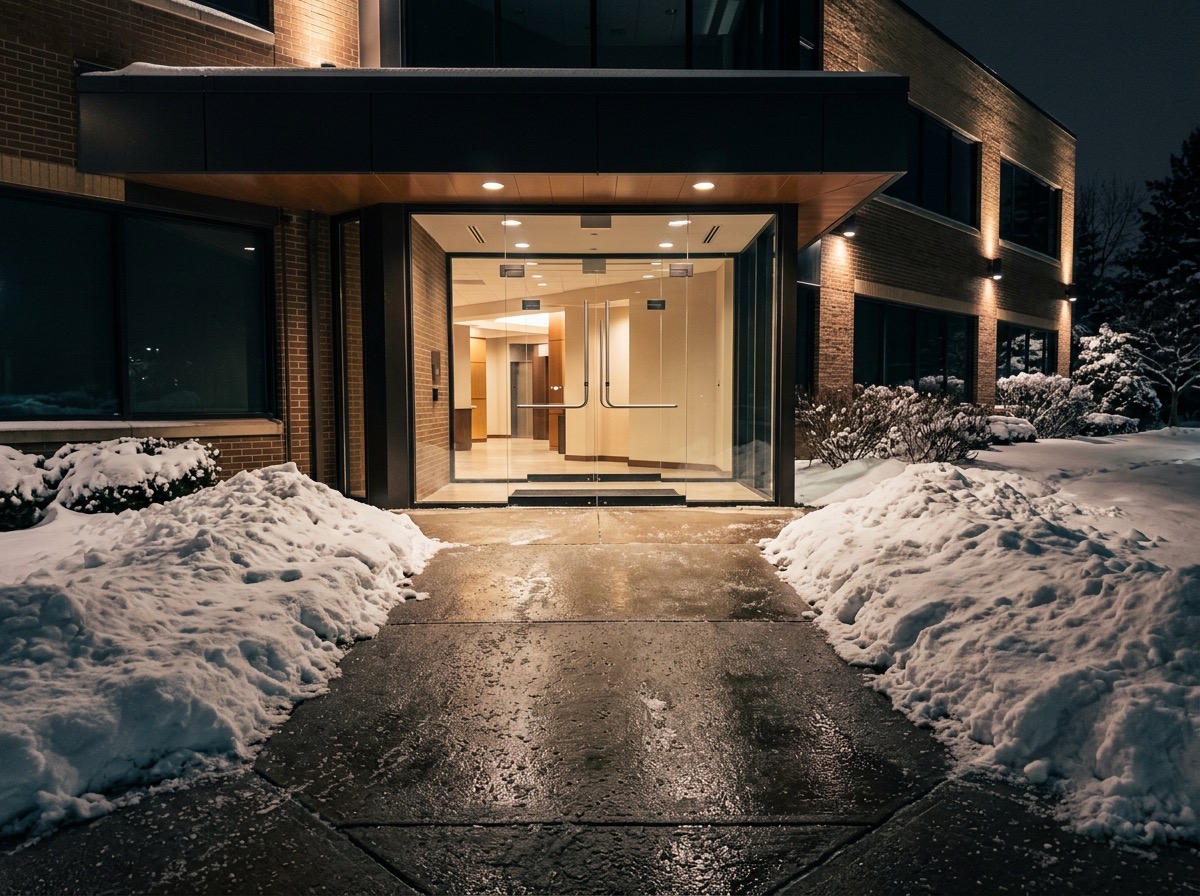
The safety reason is simple. A windrow pushed into a lane on Yonge Street or King Street at 4 a.m. is a hazard for the next driver and creates more work for the Town plow, which then pushes it back across your entrance. It also blocks drains at the curb, and when it melts, water pools at the edge of your lot and refreezes overnight. That glare ice at the entrance is a slip-and-fall risk, and slip-and-fall claims come with their own rules. See our guide to Ontario's 60-day snow and ice notice rule.
Who clears the sidewalk in front of my business?
In Midland, the Town does. Its winter maintenance page says it uses sidewalk machines to push or blow snow, but not down to bare pavement, and that residents are not required to clear the Town sidewalk out front. After a storm, the Town works on downtown areas, parking lots and sightline areas once roads are in shape.
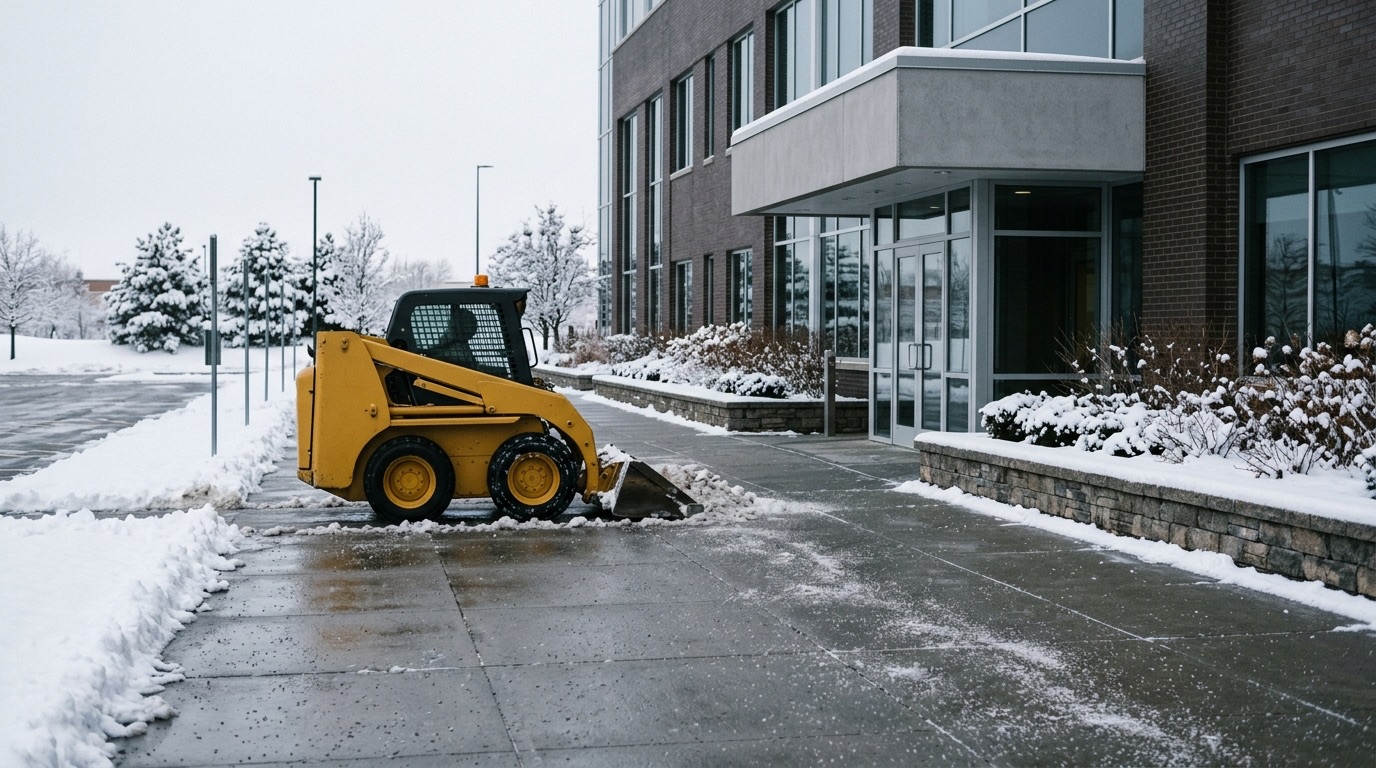
Your private walkways, steps, ramps and the path from the lot to your door are yours. Keep the line between the two clear in your contract and on your site map. It matters for liability too: a fall on the Town sidewalk is a claim against the Town with a 10-day notice period, while a fall on your walkway falls under the 60-day rule.
Why does snow pile placement on a site map matter so much?
Because every rule above is really a rule about where snow ends up. A good site map, drawn before the first storm and kept in the truck, shows:
- the storage areas, sized for a heavy winter, not an average one;
- hydrants, drains, catch basins and fire routes, each with a no-pile buffer;
- accessible parking spaces and the path to the entrance, cleared first;
- sightlines at every exit onto the street, where piles must stay low;
- property lines, especially next to Town lots and neighbouring businesses;
- landscape features that plows can damage: curbs, armour stone, garden beds, lawn edges and young trees.
This is where our design-build background helps. We built much of our reputation on retaining walls, grading and drainage, so we read a site the way water does. A pile placed uphill of an entrance melts across the walkway every afternoon and refreezes at night. A pile dumped on a planting bed loads it with salt and kills it by spring. A pile on a lawn beside a parking lot leaves a dead brown strip in April. Placing storage downhill, on hard surfaces, away from drains and plantings, solves most of these problems before they start.
What happens when the lot runs out of room?
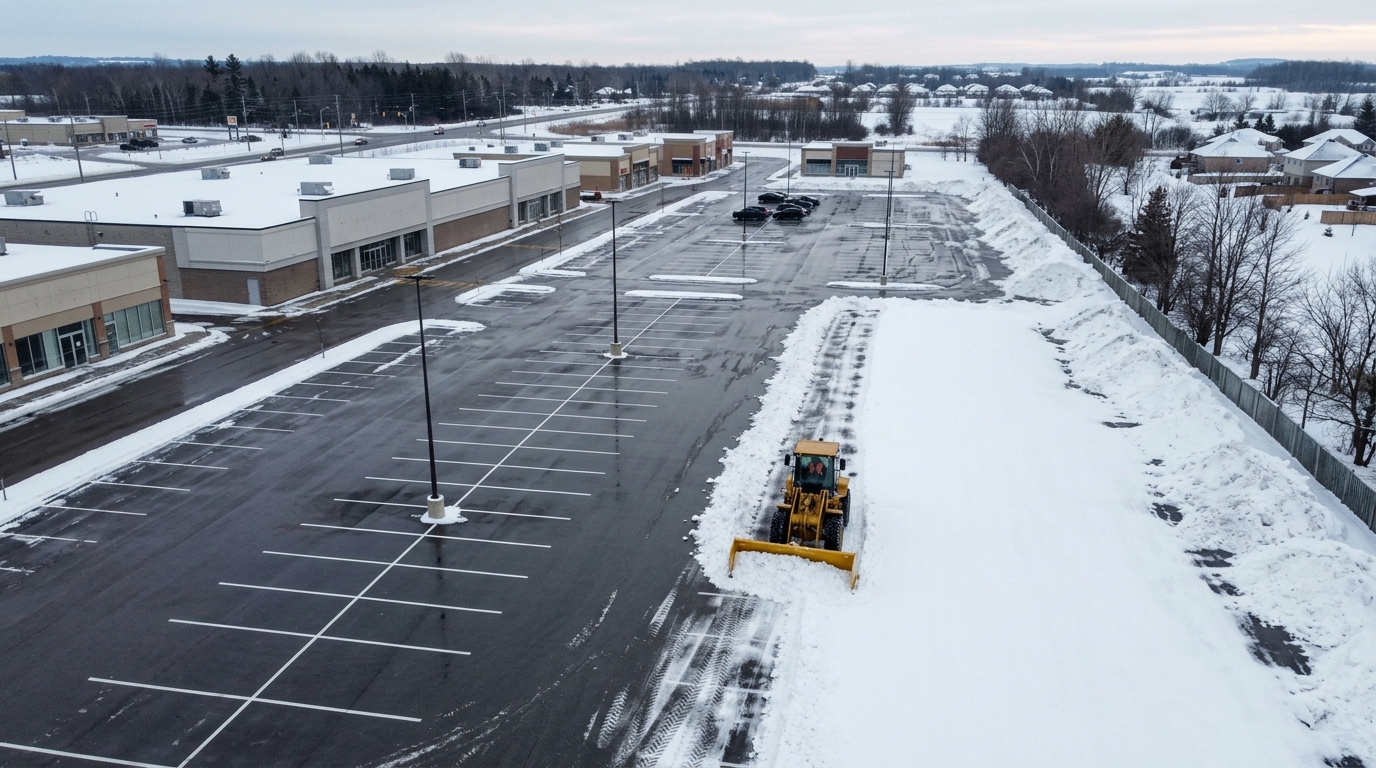
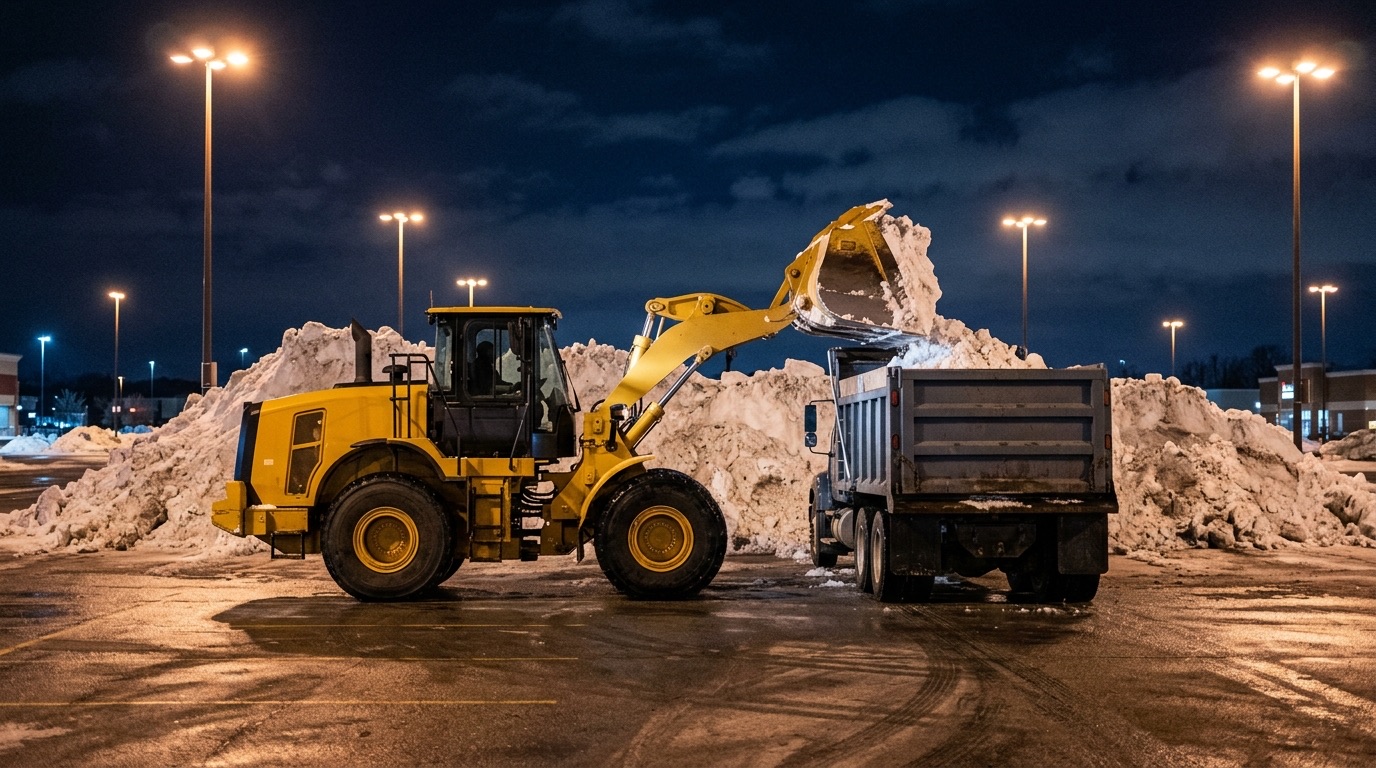
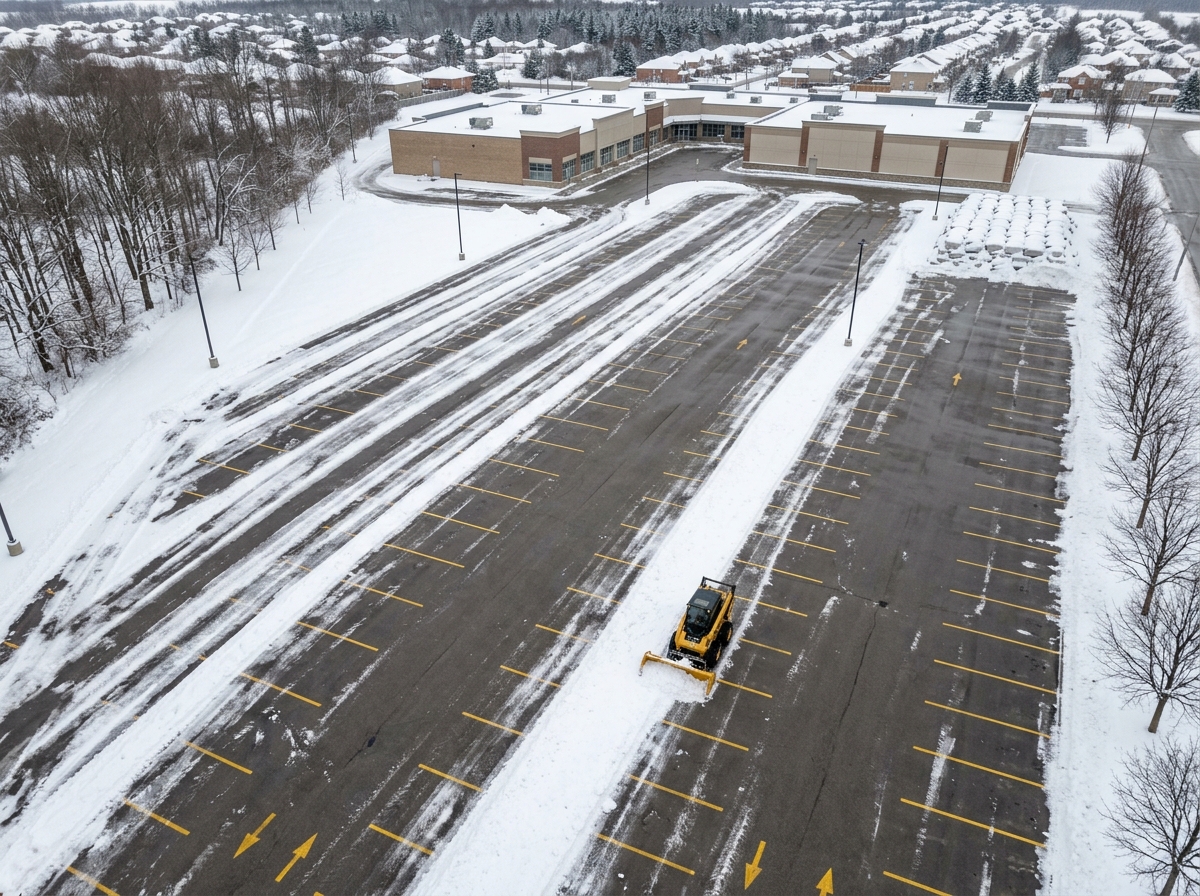
In a big winter, storage areas fill up. Pushing the overflow onto the boulevard, the sidewalk or the Town lot next door is exactly what the by-law bans. The legal options are to stack piles higher in approved spots, relocate snow within the property, or load and haul it away. A good contract names the hauling rate up front so nobody is negotiating in the middle of a February storm. See our snow hauling and removal service.
Field drawing 17 · Snow storage
Decide where the snow goes before it falls
A site map like this belongs in every commercial snow contract.
Swipe to see the full drawing →
- Store snow on the low corner. Pick low-value ground on the downhill side, with no plantings, that a loader can reach all winter.
- Near the drain, not on it. Meltwater should reach a working catch basin. A pile sitting on the grate floods the lot.
- Keep hydrants clear. Midland By-law 2025-53 bans snow on or immediately next to a fire hydrant, or anywhere that blocks access to it.
- Keep the fire route open. The by-law also bans piling snow in a fire route or an accessible space, on private property too.
- Clear accessible stalls first. Put them and the path to the entrance at the top of the priority order.
- Never on plantings. Salty snow piled on beds, islands and tree roots crushes and poisons them, and shows up as a spring repair bill.
- Keep exits low. Piles at the corners of an exit block drivers' view of the sidewalk and street. When storage fills, haul it off site.
How does a good snow contractor plan around Midland's rules?
Here is what to look for, whether you hire us or someone else.
- A pre-season site walk. The contractor should walk the property with you before the snow flies, mark storage areas, hydrants, drains and hazards, and agree on the priority order.
- A written site map. The plan should be on paper, not in one operator's head, so it survives staff changes and night shifts.
- Clear scope. The contract should say whether it covers just the lot, or also sidewalks, steps, ramps and the boulevard next to your property.
- Timing that fits the parking ban. Main clearing should happen while the lot is emptiest, with a plan for cars that stay overnight.
- Salt and sand records. Logs of each visit, with times and materials, help with both by-law questions and liability claims.
- A plan for overflow. The contract should name hauling or relocation pricing in advance.
Our full checklist is in how to choose a commercial snow removal contractor in Midland, and what these choices cost is covered in commercial snow removal costs in Midland and Penetanguishene.
How do Midland's rules compare with Penetanguishene's?
They are similar in spirit but differ in detail. Penetanguishene's traffic and parking by-law bans parking on Town streets from 1 a.m. to 7 a.m., November 1 to April 1, every year, so its ban starts two weeks earlier than Midland's. Penetang also prohibits snow on Town roads and on boulevards that do not adjoin your property, and limits snow on a corner lot to 0.7 metres high in the sight triangle. If you manage properties in both towns, read our Penetanguishene winter guide for businesses and give your contractor a separate site map for each address.
What does this look like around Midland?
- Downtown King Street. Tight lots, shared laneways and little storage space. Hauling is often part of the plan, and sidewalk clearing in front of storefronts matters as much as the lot.
- Plazas along Highway 93 and Yonge Street. Larger lots with room for storage, but busy exits where piles must stay low for sightlines.
- Industrial sites near Highway 12 and in Tay Township. Wide yards with truck traffic. Fire routes and hydrants need to stay clear for safety and inspections.
- Condos and apartments near Midland Bay. Overnight resident parking and accessible spaces make the site map and the priority order especially important.
Get a Midland snow plan that follows the rules
Keep your snow on your own property, away from hydrants, drains, accessible spaces, fire routes and sightlines, and plan around the overnight parking ban. The hard part is doing that every storm, all winter. We start every commercial job with a pre-season site walk and a written proposal that shows where snow will be stored and what gets cleared first.
Request a pre-season site walk and snow removal quote, or learn more about snow removal in Midland and our commercial snow removal service. Before you brief tenants or staff, confirm this season's parking dates and any by-law changes with the Town of Midland.
Plan your snow contract before the first squall.
We walk your site, map where the snow goes and send a written proposal. Plazas, offices, condos, churches and industrial yards.
Forty-Five Scapes did an amazing job on my property. I started with such a mess, mud and weeds and poor grading. I met with Mark and he put my mind at ease. He took my wants and needs and budget and created a vision. The crew was always on time and respectful and the end product was amazing. I look forward to many years with my amazing outdoor space.
Frequently asked questions
No. Midland's Snow Removal By-law 2025-53 says no person shall deposit, or permit or aid in depositing, snow or ice on a highway, roadway or sidewalk, and the set fine is $300. Ontario's Highway Traffic Act has a similar rule for roadways. It covers your plow contractor as well as you, so your contract and site map should keep every pile on your own property.
From November 15 to April 1, the Town bans parking on Town streets and in municipal lots from midnight to 7 a.m., whether or not it is snowing. During a declared Significant Weather Event, on-street parking is banned at all hours until the event ends. Vehicles can be ticketed or towed. Confirm the current dates on the Town's winter parking page before briefing tenants or staff.
Under By-law 2025-53 you cannot put snow on a road or sidewalk, on Town property, on a neighbour's land, on a boulevard that is not next to your property or that blocks a driver's view, on or beside a hydrant, over a Town drain, or in an accessible space or fire route. Because boulevards count as Town property, do not use them to store lot snow.
Most offences carry a $300 set fine. Snow in an accessible parking space or fire route is $500, and ignoring an order is $500. After one notice in a calendar year, the Town can clean up repeat problems without further warning and add the cost to the tax roll, with a lien possible over $1,000. Court fines can reach $100,000.