In Ontario in 2026, armour stone costs roughly $45 to $250 per ton at the quarry, and an installed armour stone retaining wall typically runs $60 to $90 per square foot of wall face for a 3 to 4 ft garden wall, or $85 to $120 per square foot for taller engineered and shoreline walls. Delivery, access, base preparation, drainage and permits make up much of the total.
Key takeaways
Armour Stone Landscaping Costs: 2026 Cost Breakdown for Ontario Homeowners
In Ontario in 2026, armour stone itself costs roughly $45 to $250 per ton at the quarry, depending on size and whether it is split, and an installed armour stone retaining wall typically runs about $60 to $90 per square foot of wall face for a 3 to 4 ft garden wall and $85 to $120 per square foot for taller engineered or shoreline walls. Delivery, site access, base preparation and drainage stone make up much of the difference between the stone price and the finished wall.
This guide breaks down each of those costs for armour stone landscaping, using published Ontario supplier and contractor pricing and our own installations around Midland and Georgian Bay, so you can read a quote line by line.
1. Introduction: Why Cost Transparency Matters
Armour stone projects can swing from a modest $3,000 garden wall to a $60,000 shoreline overhaul. Without an itemised budget, sticker shock is inevitable. Clear cost expectations allow you to:
- Prioritise high‑impact features first.
- Compare contractor quotes apples‑to‑apples.
- Phase construction logically if you need to spread expenses over time.
Forty Five Scapes believes an informed client is a happy client, so let's unpack those numbers.
2. What Is Armour Stone and Where Does It Come From?
2.1 Natural Durability & Aesthetic Appeal
Armour stone is large quarried rock, most often limestone in Ontario, cut or split into rough rectangular blocks. Landscape-sized blocks commonly weigh from under a ton to 3 tons or more, and that mass is what lets a dry-laid wall resist frost, wave action and soil pressure. The rugged faces and natural colour variation also look different from manufactured wall blocks.
2.2 Quarry Sources: Limestone vs. Granite vs. Sandstone
- Limestone: Cream to blue-grey tones and the most common armour stone in Ontario, quarried on the Bruce Peninsula, Manitoulin Island and elsewhere in the province. Large 1 to 4 ton pieces are often in the $45 to $75 per ton range at the quarry.
- Granite: Pink and salt-and-pepper tones, very hard and slightly denser than limestone. It is harder to cut into regular blocks, so it is usually priced above limestone.
- Sandstone: Warm earth tones and softer edges. Less common for structural walls.
Quick reference: Expect quarry-gate pricing between $45 and $250 per ton depending on piece size, cut and order size. Large 2 to 4 ton blocks are the cheapest per ton; small, hand-placeable landscape pieces on skids are the most expensive (Quest Stone price list).
3. Six Core Factors That Drive Armour Stone Landscaping Costs
3.1 Stone Size & Height Requirements
Taller retaining walls need deeper and heavier blocks. A 15‑inch‑high stone (~0.75 ton) costs less to buy and crane than a 30‑inch giant (~3 tons).
3.2 Weight & Density (Cost‑per‑Ton)
Ontario suppliers list armour stone at roughly $45–$250 per ton (Quest Stone). Weight drives trucking too: each truck can only carry so many tons, so a wall built from heavy blocks needs more loads.
3.3 Quarry Location & Transportation Fees
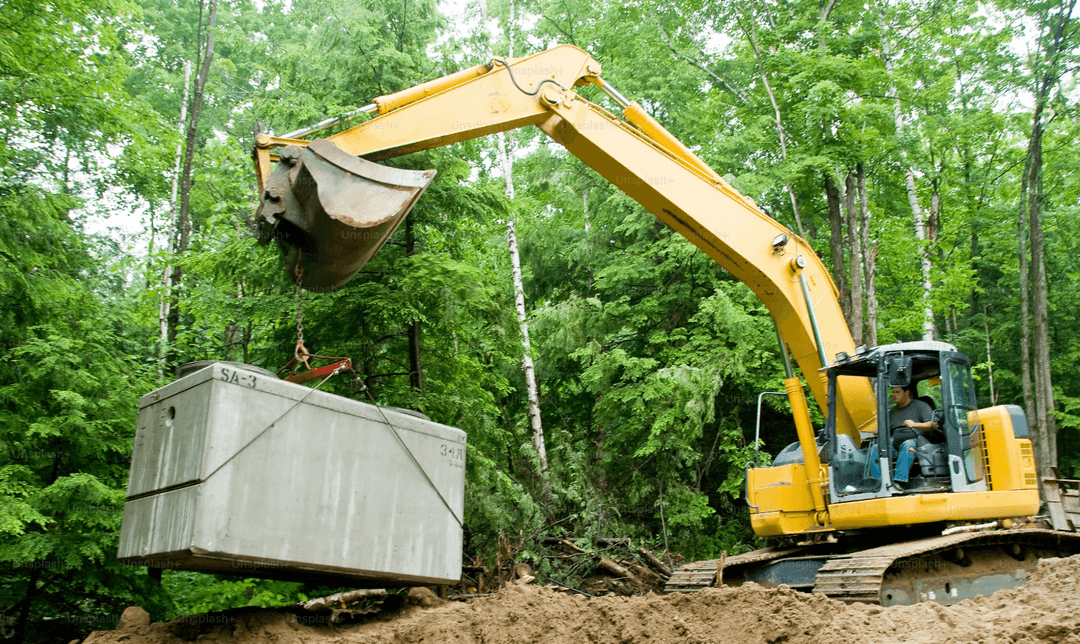
Transport can be a large share of the material cost, especially when the quarry is far from the site. Most stone yards charge per load or per hour of trucking, so ask for delivery to be quoted separately. Waterfront and island properties may also need barge delivery, which is priced on its own.
3.4 Site Access, Excavation & Base Prep
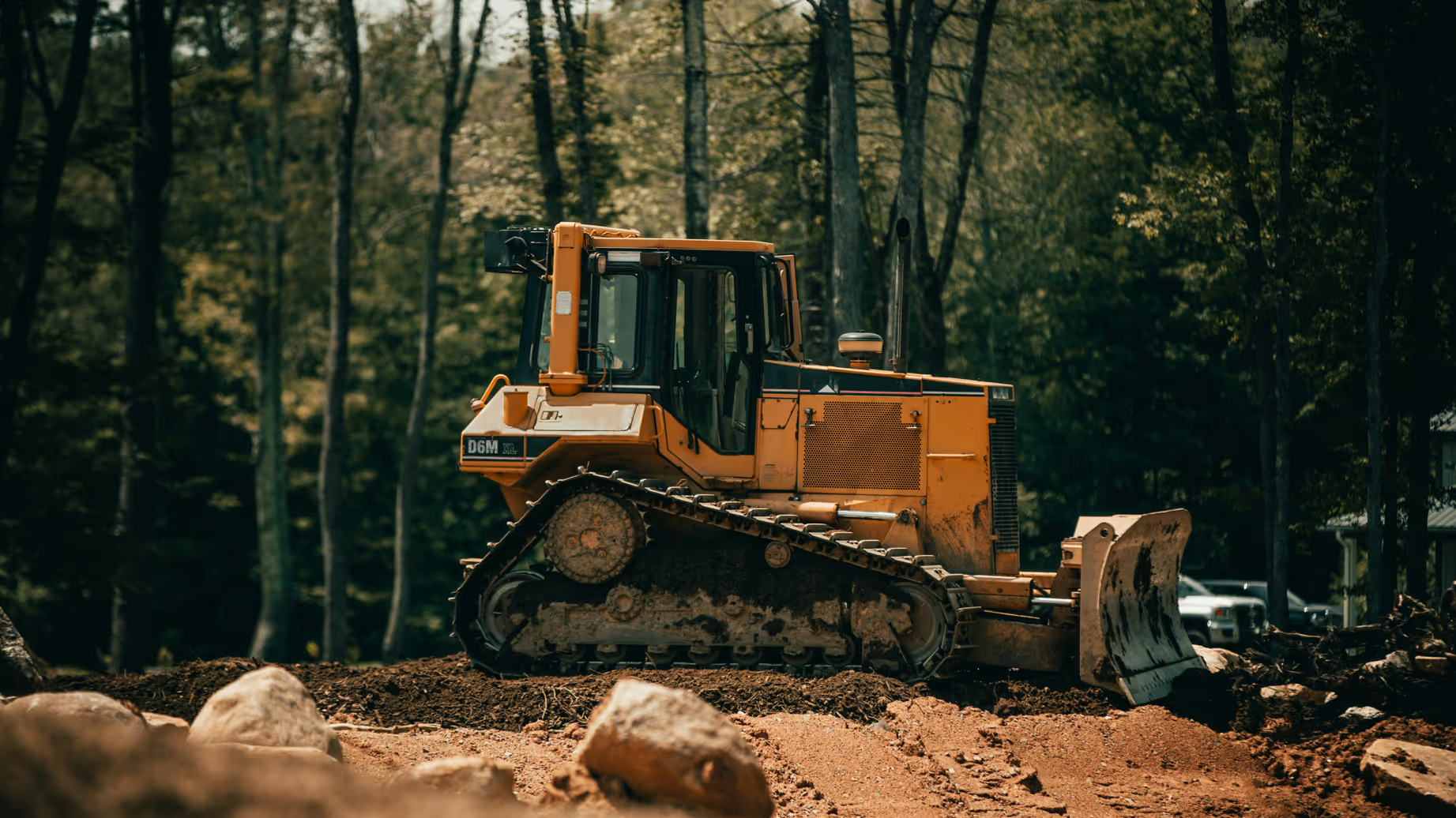
If your backyard gate is narrower than 8 ft, crews must crane stones over the house or hand‑dolly smaller pieces—both premium‑priced scenarios. Excavation and compacted‑gravel bases add $8–$15 per sq ft.
3.5 Labour: DIY vs. Professional Installation
- DIY: Equipment rental (mini‑excavator, plate compactor) ≈ $700/weekend plus delivery.
- Pro Crew: Installation crews typically charge $60–$85 per hour per worker, averaging $22–$35 per sq ft for labour alone.
3.6 Seasonal Demand & Market Fluctuations
Spring is the busiest time for stone yards and installers, when cottage owners line up shoreline repairs after ice and high water. Booking early, or scheduling non-urgent work for later in the season, gives you more choice of dates and crews.
4. Cost Breakdown by Project Type
4.1 Retaining Walls
Retaining walls dominate armour stone use, and pricing hinges on wall height, drainage spec, and access. Every armour stone wall is built the same basic way: a compacted granular pad, a first course set partly below grade, each course stepped back into the slope, and clear stone with a drain behind it.
Field drawing 10 · Armour stone
Armour stone walls hold by weight and setback
Each course leans back into the slope and sits on the one below. Drainage still matters.
Swipe to see the full drawing →
- Compacted granular pad. Granular A, compacted, wider than the base stone. Soft ground gets dug out first.
- Embed the base stone. The first course sits partly below grade so it can't kick out at the toe.
- Step each course back. The batter puts each stone's weight behind the one below. Set stones on their flattest faces.
- Clear stone behind. Free-draining stone in the joints and behind the wall relieves water pressure.
- Drain to daylight. A perforated pipe at the base, outletting where water can't undercut the wall.
- Fabric against the soil. Non-woven fabric between drainage stone and native soil. Walls over 1 m next to public areas need a permit and an engineer.
The stone you see is only part of the price. The excavation, base, buried first course and drainage behind the wall are where cheap quotes cut corners, and they are what keep the wall from leaning in a few years. Our step-by-step guide to installing armour stone retaining walls covers the build sequence in more detail.
4.1.1 Garden Walls (3–4 ft)
- Materials: $40–$60 per sq ft (stone + gravel + geotextile)
- Labour: $20–$30 per sq ft
- Total: $60–$90 per sq ft or roughly $6,000–$9,000 for a 100 sq ft face.
4.1.2 Shoreline & Structural Walls (5–8 ft)
Often needs an engineered design, heavier blocks and more drainage:
- Materials: $55–$75 per sq ft
- Labour & Equipment: $30–$45 per sq ft
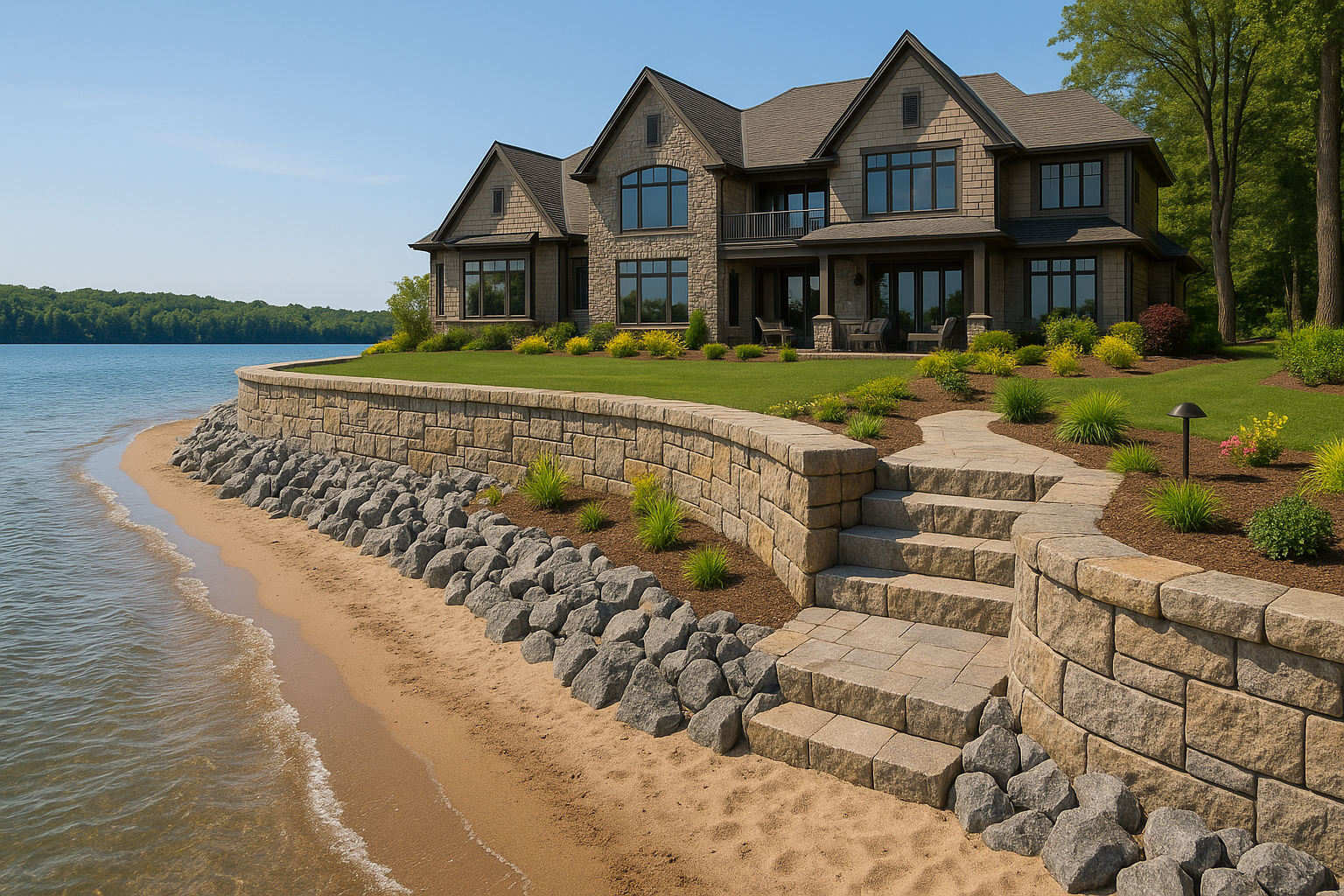
- Total: $85–$120 per sq ft, topping $30,000 for modest shorelines. For comparison, Brock Excavation puts typical armour stone walls at $40 to $100 per square foot including materials and labour.
4.1.3 How many stones does a wall need?
To estimate stone count, divide the wall length by the length of one stone, then multiply by the number of courses (wall height divided by stone height). A 40 ft wall built from 4 ft long, 18 in high stones needs about 10 stones per course; at 3 ft high that is two courses, or about 20 stones, plus a buried base course on most walls. Per linear foot, a 3 ft garden wall at $60 to $90 per square foot works out to roughly $180 to $270 per foot of wall installed.
4.2 Steps & Staircases
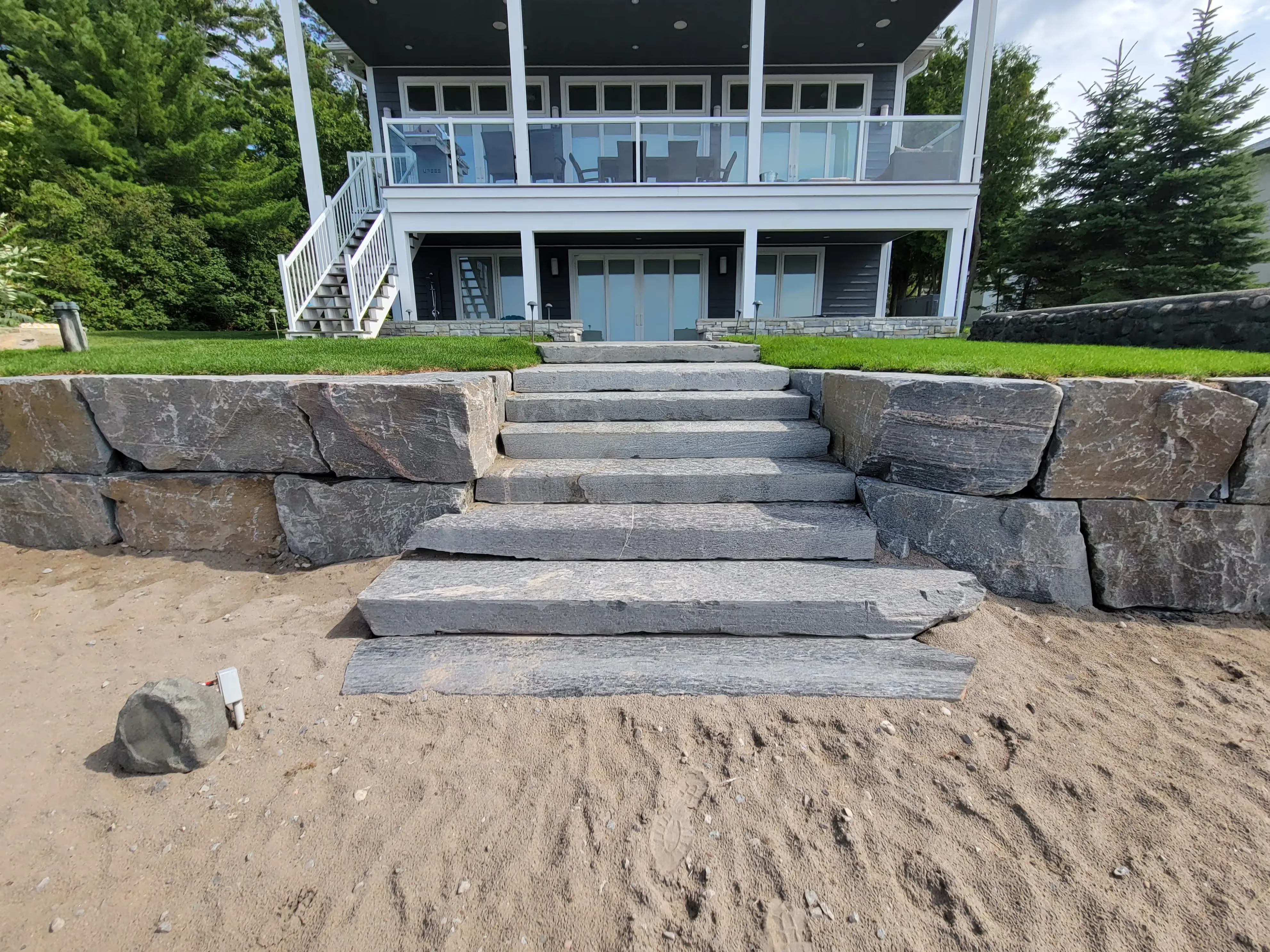
Stone treads cost $300–$550 each (including skid‑steer placement). A six‑step stair often lands between $4,000–$6,500 installed.
4.3 Driveway Edging & Garden Borders
Using 15–17‑inch stones:
- Material: $50–$70 per linear ft
- Installed: $80–$110 per linear ft
4.4 Ponds, Waterfalls & Water Features
Budgets vary wildly. Expect $2,500 minimum for a simple three‑stone cascade up to $25,000+ for multi‑tiered ponds with pumps and lighting.
5. Hidden & Ongoing Costs Homeowners Forget
5.1 Drainage Aggregate & Geotextile Fabric
A washed clear-stone backfill layer lets water drain away instead of building up pressure behind the wall. Budget $15–$25 per sq ft of wall face for ¾-inch clear stone plus non-woven geotextile. Under the wall, the pad should be compacted Granular A, not clear stone, which does not compact into a stable base.
Field drawing 02 · Materials
Which aggregate goes where
Six materials do most of the work under a landscape. Mixing them up is the most common base failure.
Swipe to see the full drawing →
- Granular A. Dense-graded crushed stone (OPSS 1010). The compacted base under patios, walkways and driveways.
- Granular B. Coarser dense-graded material (OPSS 1010). Used as subbase under Granular A where loads or soft soils call for it.
- Clear stone. Washed, with no fines, so water moves through it. Use behind retaining walls and in French drains, never as a paver base.
- Bedding layer. About 25 mm of bedding under pavers, screeded flat. ICPI calls for a nominal 1 in (25 mm).
- Topsoil. Screened and stone-free. Municipal sod specs call for 150 mm or more over loosened subsoil.
- Armour stone. Quarried blocks set on a compacted granular base, used for gravity walls, steps and shoreline toes.
If a quote lists only "stone and labour", ask what goes under and behind the wall, how deep the base is, and where the drain outlets. Those materials are a small part of the total but decide how long the wall lasts.
5.2 Permit & Engineering Fees
Under the Ontario Building Code, a retaining wall more than 1 metre (3.3 ft) high next to public property, a building entrance, or private property open to the public needs a building permit and an engineered design. Shoreline work on Georgian Bay can need an MNRF work permit, Fisheries and Oceans Canada may review in-water work, and some properties fall under conservation authority regulations. Engineering stamps typically run $800–$1,800; municipal permits $150–$450. See our guide to retaining wall permits in Ontario.
5.3 Maintenance & Future Repairs
Armour stone itself lasts a very long time, but walls that lose their drainage can shift. Keep drain outlets clear and watch for stones that tip or settle; resetting a few stones is far cheaper than rebuilding a section.
6. Budgeting & Financing Your Armour Stone Project
6.1 Estimating Cost‑per‑Square‑Foot vs. Cost‑per‑Ton
- Quick yard math: Multiply wall face area (sq ft) by blended rate $70 (average) = rough total.
- Ton method: Total tonnage × delivered price per ton ($155 typical) = material subtotal, then add 35–50 % for labour & misc.
6.2 Phase‑Build Strategies for Large Projects
Break a 60 ft shoreline wall into two 30 ft phases across seasons to fit cash flow, as long as the first phase ends at a stable return or tie-in.
6.3 Financing & Home‑Equity Options
Many homeowners pay for larger stone projects with a home equity line of credit or renovation loan. Rates and terms vary by lender, so compare offers before committing, and ask your contractor about the payment schedule.
7. Seven Cost‑Saving Tips Without Compromising Quality
- Order full loads where you can, since many yards charge more per ton for partial loads.
- Mix heights strategically—use 15‑inch blocks on upper courses where pressure is lower.
- Book early or be flexible on dates so you are not competing for crews in the spring rush.
- Use Ontario limestone instead of granite if colour‑match is acceptable.
- Reuse excavated sub‑soil for non‑structural backfill where code allows.
- Combine armour stone with natural flagstone caps to reduce block count.
- Negotiate bundled services—excavation, base prep, and planting—under one contractor to cut mobilisation fees.
Planning a 2027 armour stone project
If you want armour stone work done in 2027, get the design and quote settled over the winter. Shoreline and engineered walls need drawings and approvals before a machine can start, and provincial or federal reviews for work on Georgian Bay can take weeks. Applying in winter keeps spring open for construction. Around Midland the ground usually thaws in late April or May, and heavy trucks and excavators stay off soft lawns and laneways until it firms up.
Use the planning time to decide wall height and layout, since height sets whether you need an engineer and how big the stones must be. Decide where the water behind the wall will drain. Ask whether a long wall can be split into two shorter terraced walls, which often avoids the 1 m engineered-wall threshold and uses smaller, cheaper stone. On waterfront lots, a planted buffer above a stone toe is worth considering for 2027 designs because it needs fewer large stones and keeps more of the shoreline natural.
- Winter: site visit, design and itemized quote.
- Late winter: engineering and permit applications where needed.
- Late April to May: excavation and base once the ground is firm.
- Summer: stone placement, backfill, planting.
8. Frequently Asked Questions About Armour Stone Landscaping Costs
Q1. How much does a small armour‑stone garden wall cost in Midland?
A simple 20 linear‑ft wall, 3 ft high, averages $4,000–$5,500 installed.
Q2. Is armour stone cheaper than concrete blocks?
Usually not for low walls: manufactured concrete wall blocks are often cheaper per square foot on small, easy-access jobs. Armour stone becomes more competitive on taller walls, waterfront sites and rough ground, where its weight and durability count for more.
Q3. Can I buy armour stone by the piece instead of by the ton?
Yes. Some yards sell smaller landscape pieces individually or by the skid; price depends on size and finish.
Q4. Does DIY installation really save money?
Only if you already have equipment experience. Renting machinery and correcting mistakes can erase savings quickly.
Q5. How long does delivery take after ordering?
Lead times vary by quarry, stone size and season. Ask when you order, and expect longer waits in spring.
Q6. Will my project need a permit?
A wall over 1 m high next to public property or a building entrance needs a building permit and engineered design under the Ontario Building Code. Shoreline work may need MNRF, DFO or conservation authority approval. Check with your municipality before you order stone.
Q7. How much does armour stone cost per linear foot?
For a 3 to 4 ft garden wall at $60 to $90 per square foot of face, expect roughly $180 to $360 per linear foot installed. Edging with single 15 to 17 in stones runs about $80 to $110 per linear foot installed.
9. Next Steps With Forty Five Scapes
Armour stone lasts for decades when the budget covers the parts you cannot see as well as the stone itself. Whether you need a cottage‑shore revetment or a statement staircase, Forty Five Scapes provides turnkey service: design, permitting, supply, and installation—all backed by a five-year warranty. See our armour stone landscaping services for examples.
Ready for a line‑item quote that respects your budget? Book a free on‑site estimate today and let's build an outdoor space your family will love for decades.
Planning a project this season?
We’ll walk the site, scope it properly and give you a straight price.
Forty-Five Scapes did a fantastic job replacing the broken concrete retaining wall at the end of our driveway with beautiful armour stone. They were punctual, worked long/hard days and finished the job extremely quickly. We couldn't have asked for better service!
Frequently asked questions