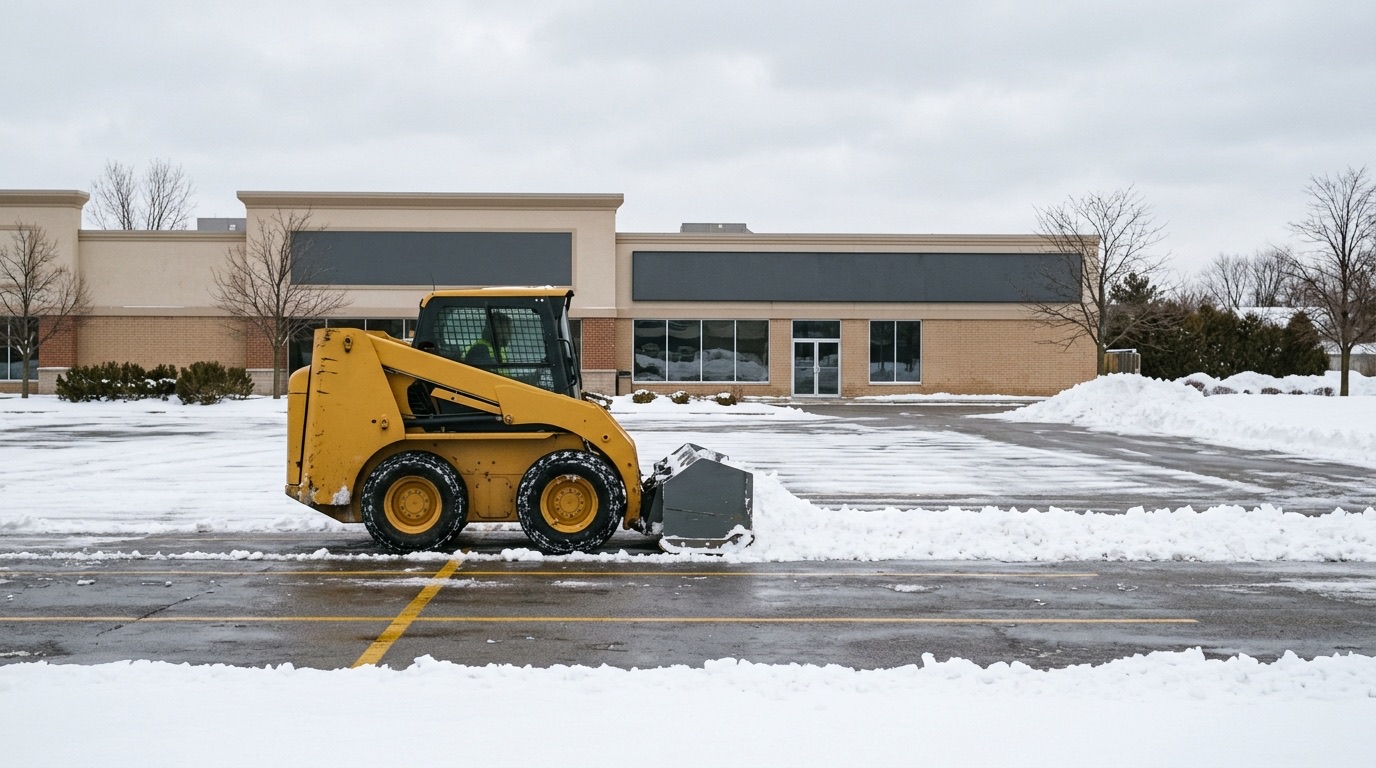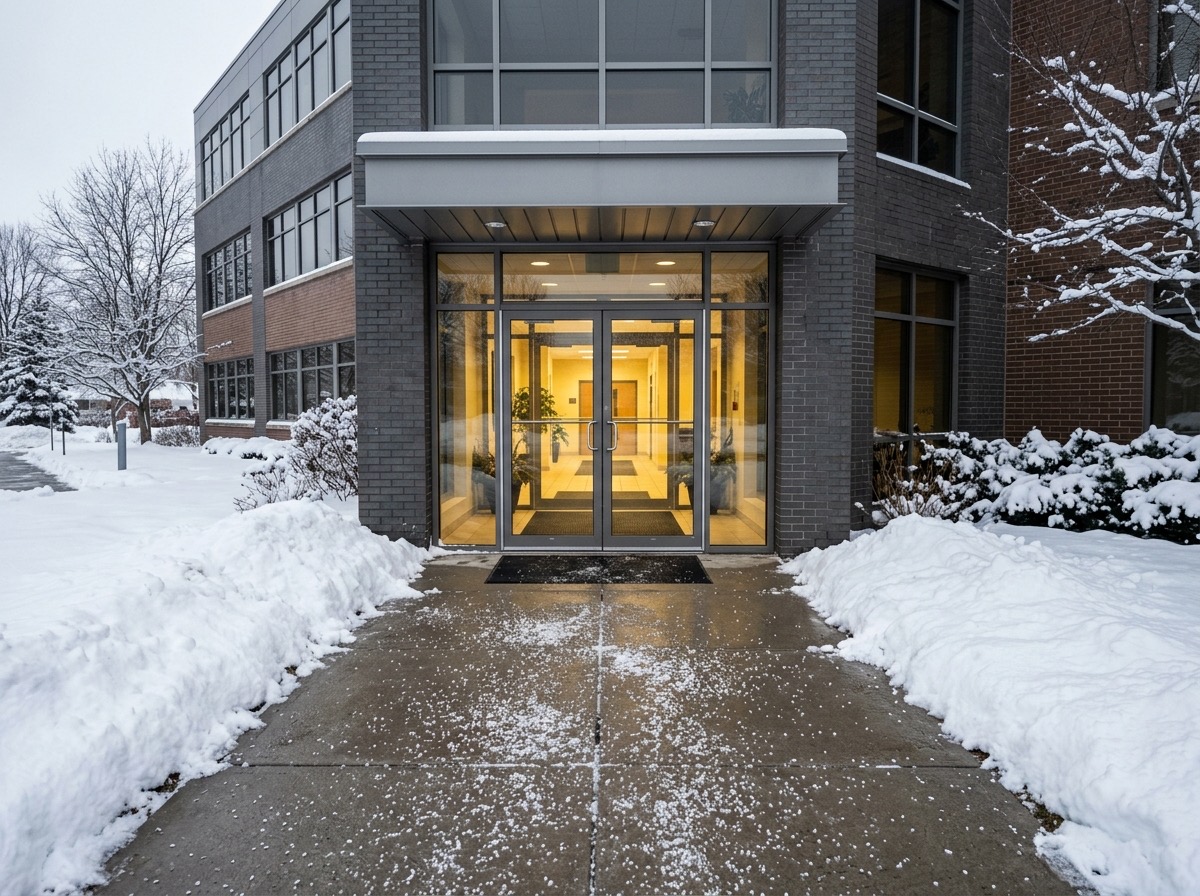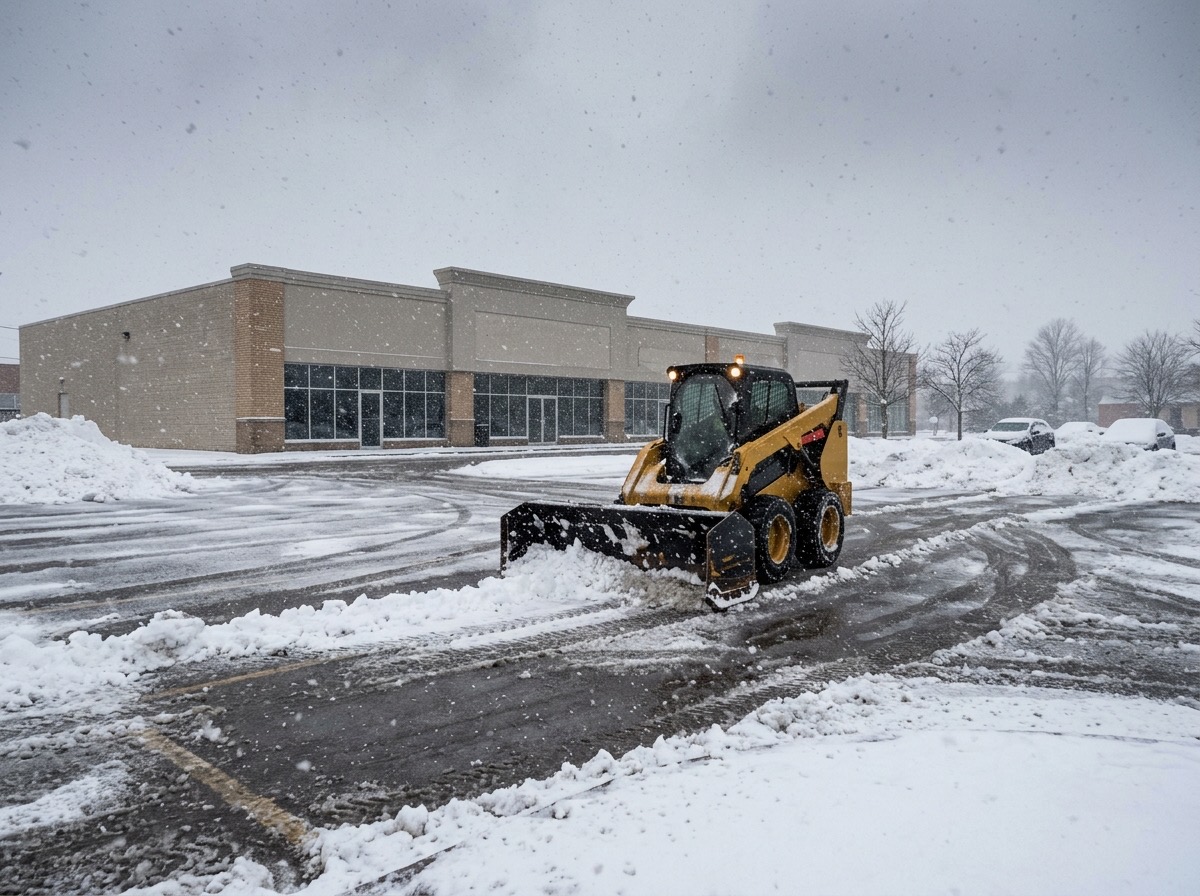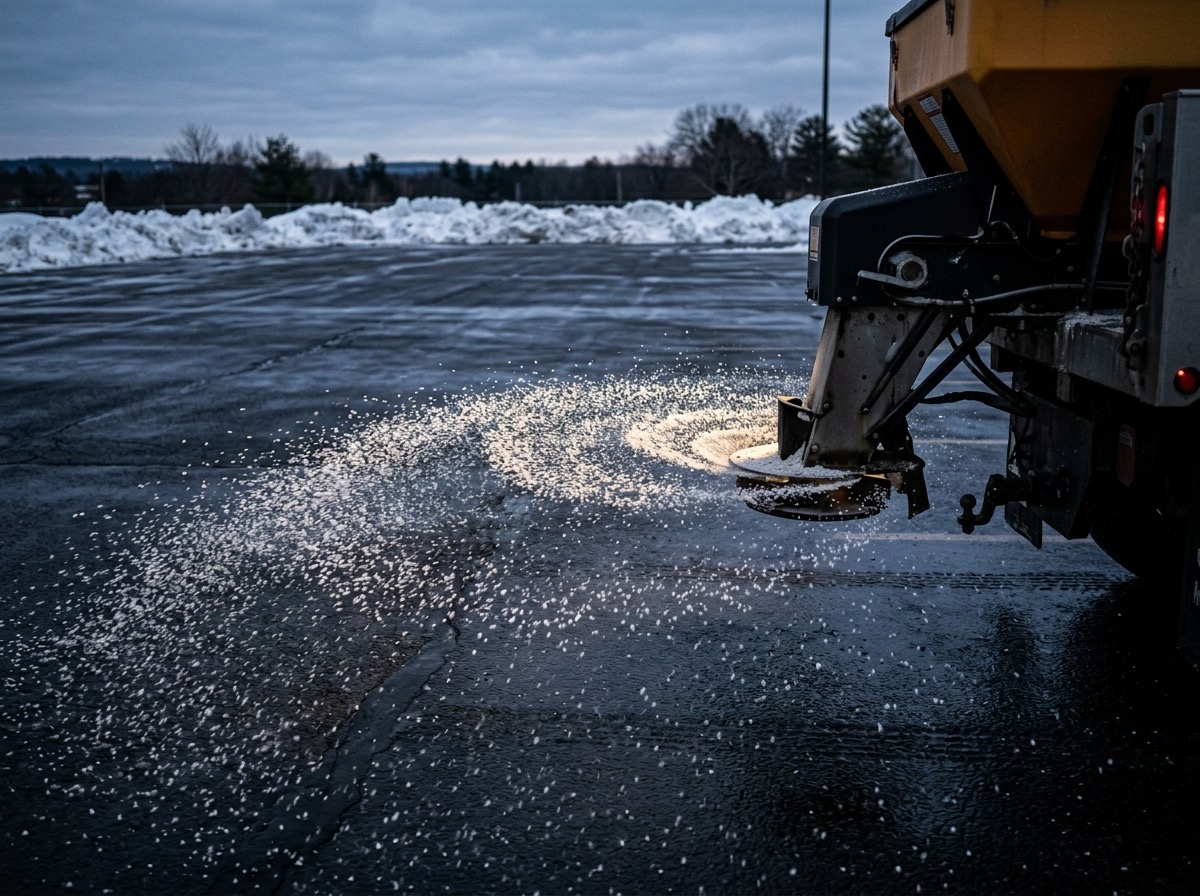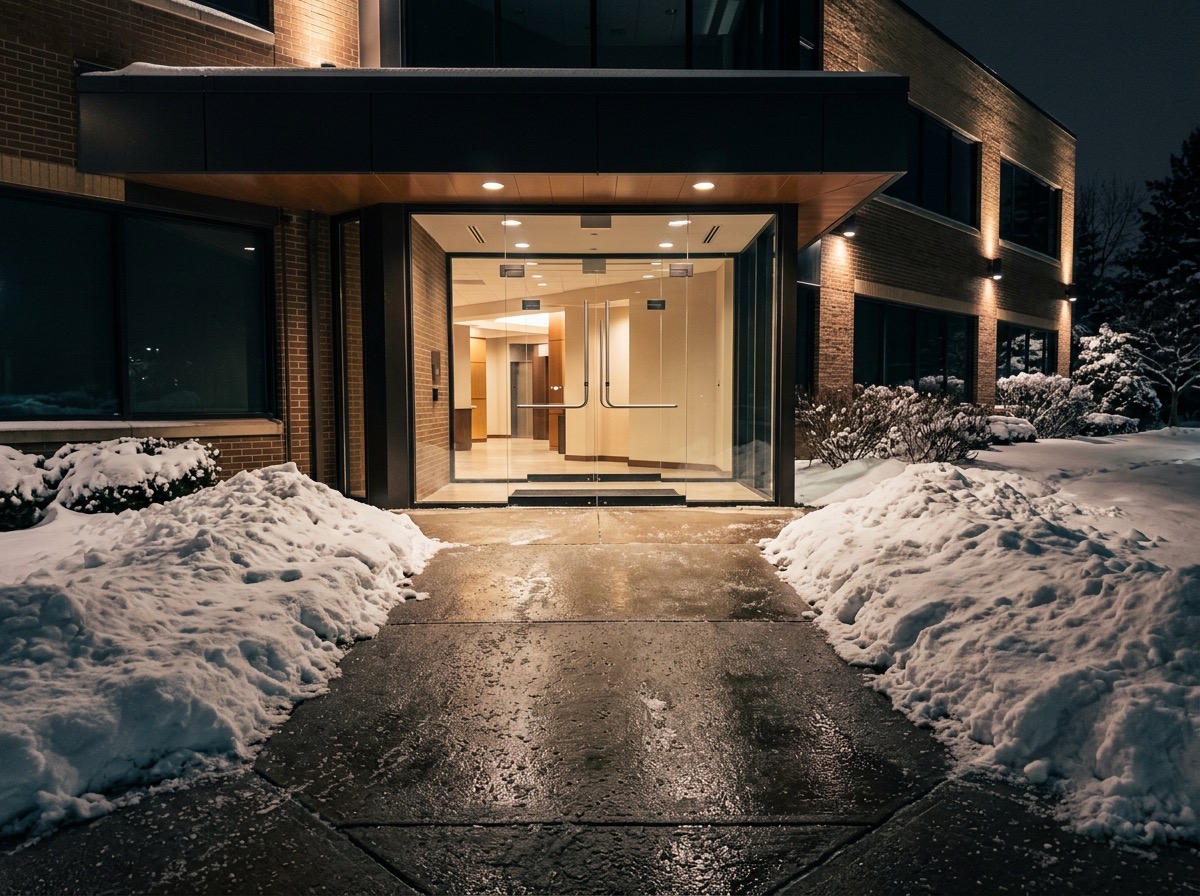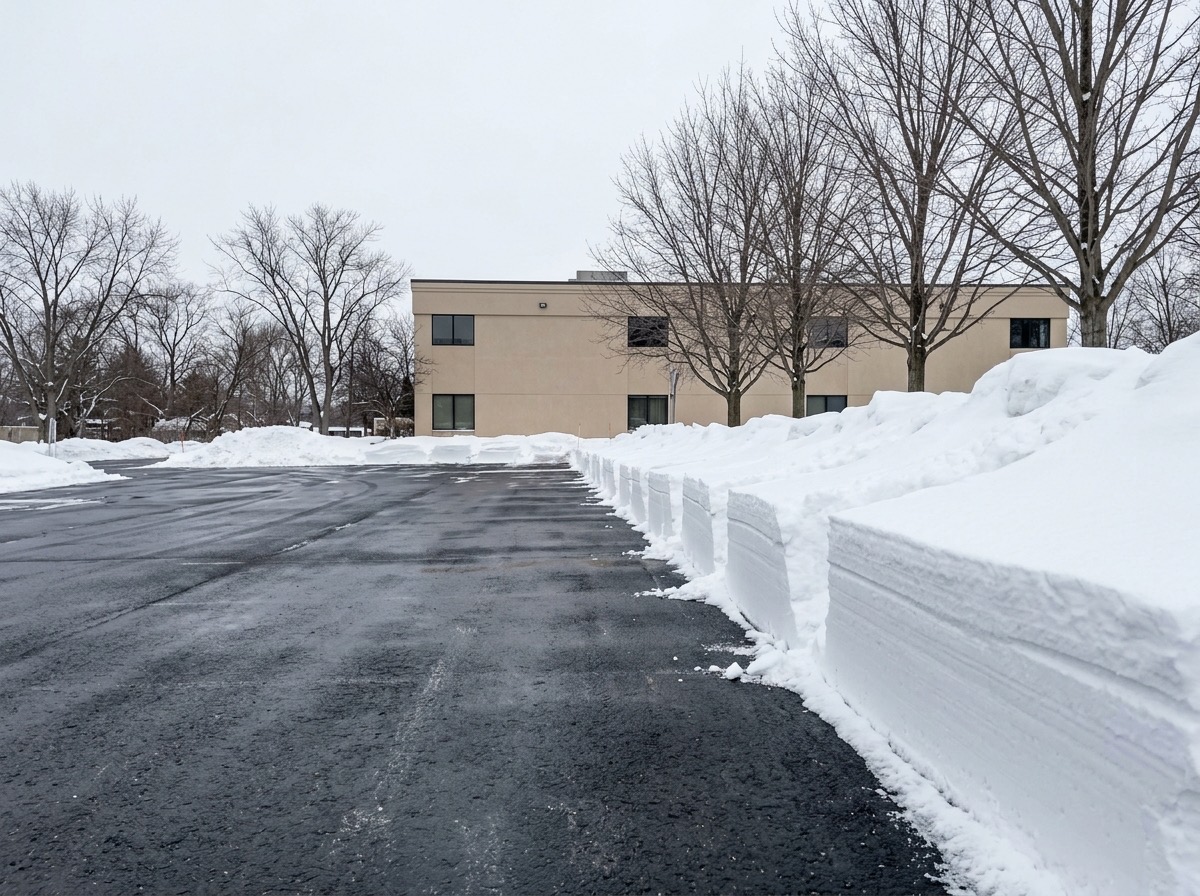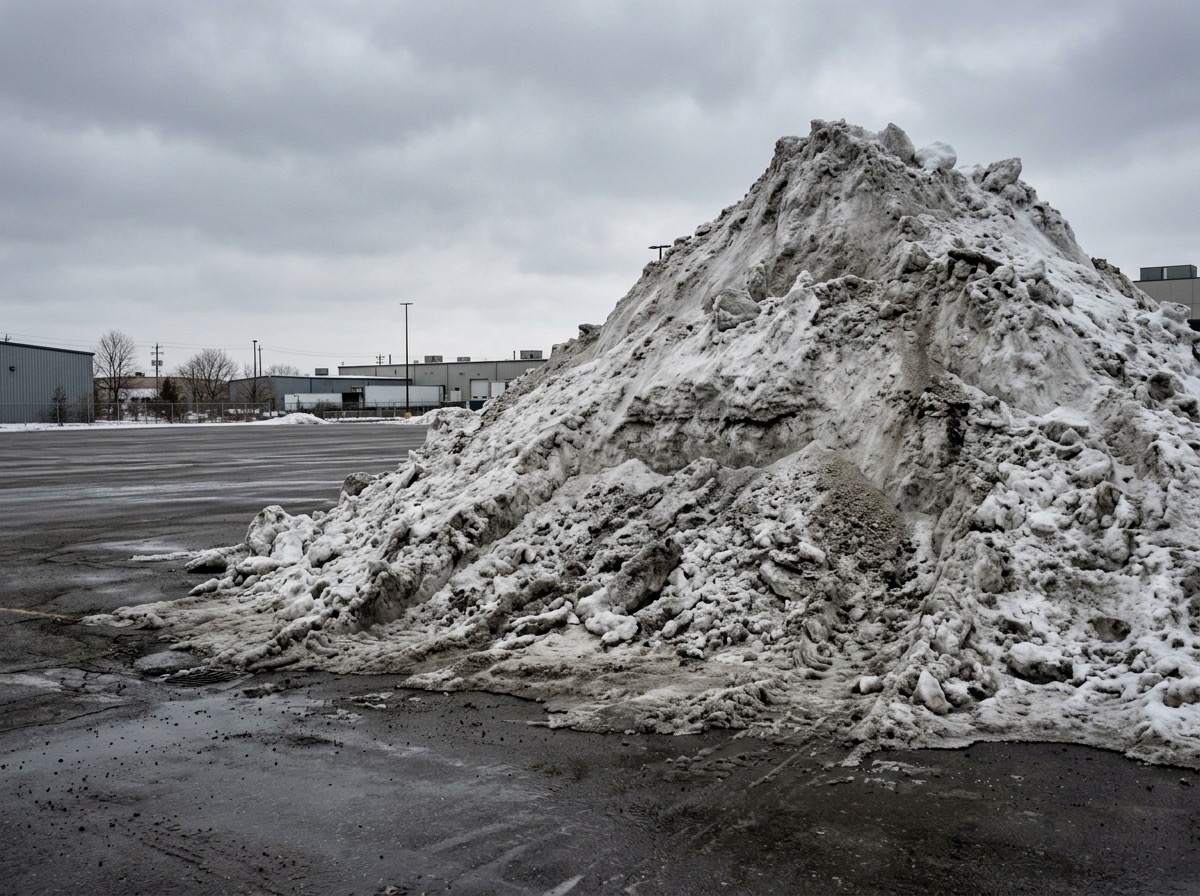
Pick snow storage before the season on low-value ground at the lot edge, downhill of traffic and near a working drain, clear of hydrants, fire routes, accessible spaces, sightlines and landscaping. Size it for a heavy winter, haul when it fills, and fix poor grading in spring.
Key takeaways
Last updated: November 2026
Where should you put snow on a commercial parking lot? On a spot you choose before the first storm: a low-value corner of the lot or a pad of open ground that sits downhill of nothing important, clear of catch basins, sightlines, fire routes and accessible spaces, and well away from planting beds, trees, sod and armour stone. Mark that spot on a site map, give it to your contractor, and plan when the pile gets hauled away once it outgrows the space.
We look at this from a slightly different angle than most snow companies. We are a design-build landscaper, so we are usually the people called in April to replace the dead sod, the cracked curb stone and the shrubs that spent four months buried under a salty pile. A little planning in November saves most of that bill. Here is how we think about snow storage on plazas, offices, condos, churches and industrial yards around Midland and Penetanguishene.
Key Takeaways
- Pick snow storage locations before the season starts and mark them on a site map that is part of your snow contract.
- Piles belong on paved or rough ground that drains away from buildings, entrances and walkways, never on planting beds, tree roots, sod or stone features.
- Keep catch basins, drains and the downhill side of the pile clear so meltwater has somewhere to go instead of refreezing across the lot.
- Midland's Snow Removal By-law 2025-53 prohibits snow on or near fire hydrants, in accessible parking spaces, in designated fire routes, or on boulevards where it blocks a driver's line of sight.
- When the storage area fills up, haul the snow off site instead of pushing piles higher or into parking stalls.
- Size storage for a heavy winter. Every centimetre of snow on 1,000 square metres of pavement is 10 cubic metres to put somewhere.
Why does snow storage need a plan at all?
Because every push of the plow puts snow somewhere, and in a snowbelt winter that somewhere fills up fast. Midland and Penetanguishene sit on southern Georgian Bay inside Ontario's lake-effect snowbelt, among the snowiest parts of southern Ontario. A single squall off the bay can drop 10 to 20 cm or more on Midland while Barrie barely gets a dusting. Several of those in a row and the corner where the operator "just put it last year" is full by January.
How much room does snow storage need?
More than most owners expect. The arithmetic is simple: 1 cm of snow on 1 square metre of pavement is 10 litres, so every centimetre on 1,000 square metres is 10 cubic metres. Take a 2,000 square metre plaza lot and a 20 cm squall. That is 400 cubic metres of fresh snow, a pile roughly 20 metres long, 10 metres wide and 2 metres high. Plowing compacts it, so the real pile is smaller, but you are also stacking storm after storm until March.
Do this sum for your own lot before you sign a contract. If the storage areas on your site map cannot hold a few big storms, plan for hauling from the start instead of discovering it in February.
Without a plan, piles drift into the worst places. They creep into parking stalls and cost you spaces. They sit on top of the one catch basin that drains the lot. They block the view of drivers pulling out onto the road. They bury the shrubs along the front of the building and soak them in salt until the thaw. That is what happens when the decision is made at 4 a.m. in a loader cab instead of in daylight on a site map.
A storage plan also protects you. If a pile causes a problem, the first question is usually who decided to put it there. A written plan that both the owner and the contractor signed off on answers that question before it is asked.
Where should snow piles go on a commercial lot?
Good storage spots share a few traits. Walk your property with these in mind:
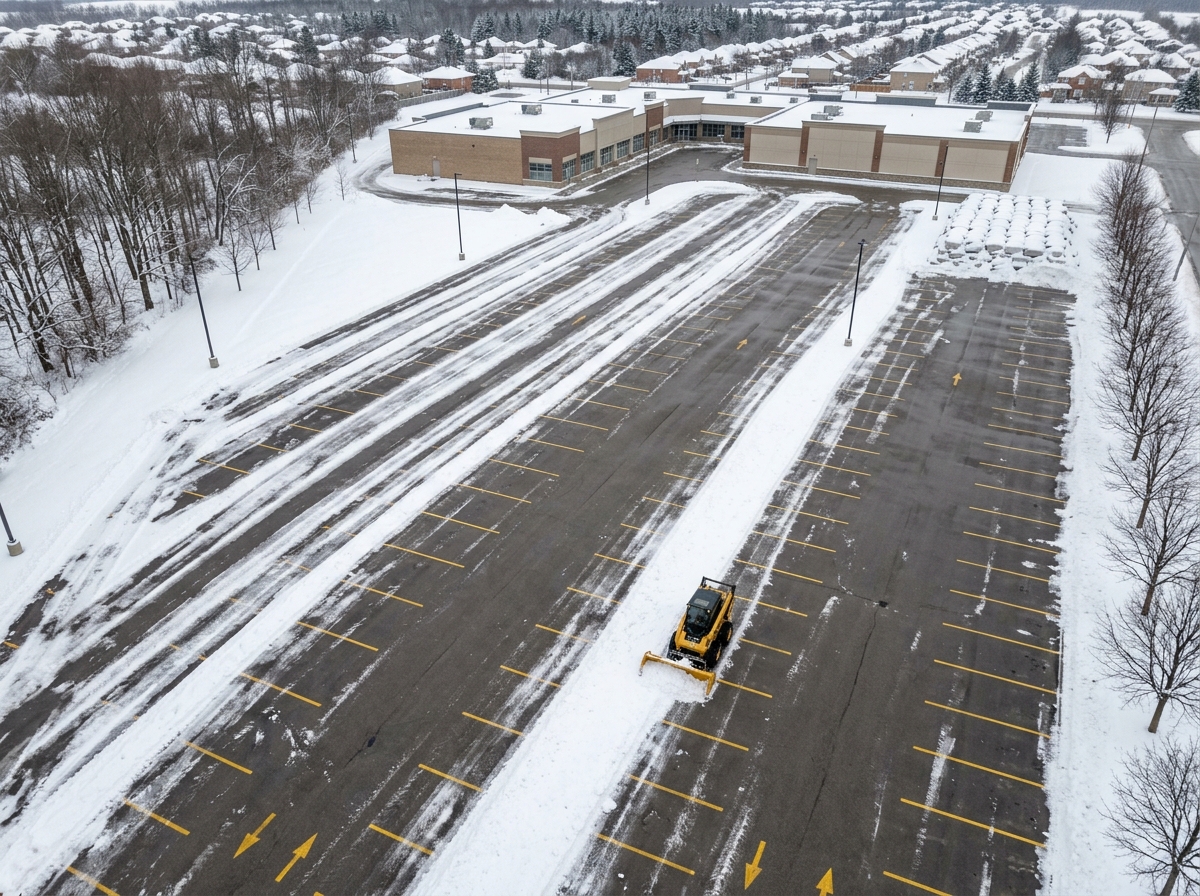
- Low-value ground. The back corner of the lot, an unused pad, the far end of a row that nobody parks in during winter, or rough open ground with no plantings.
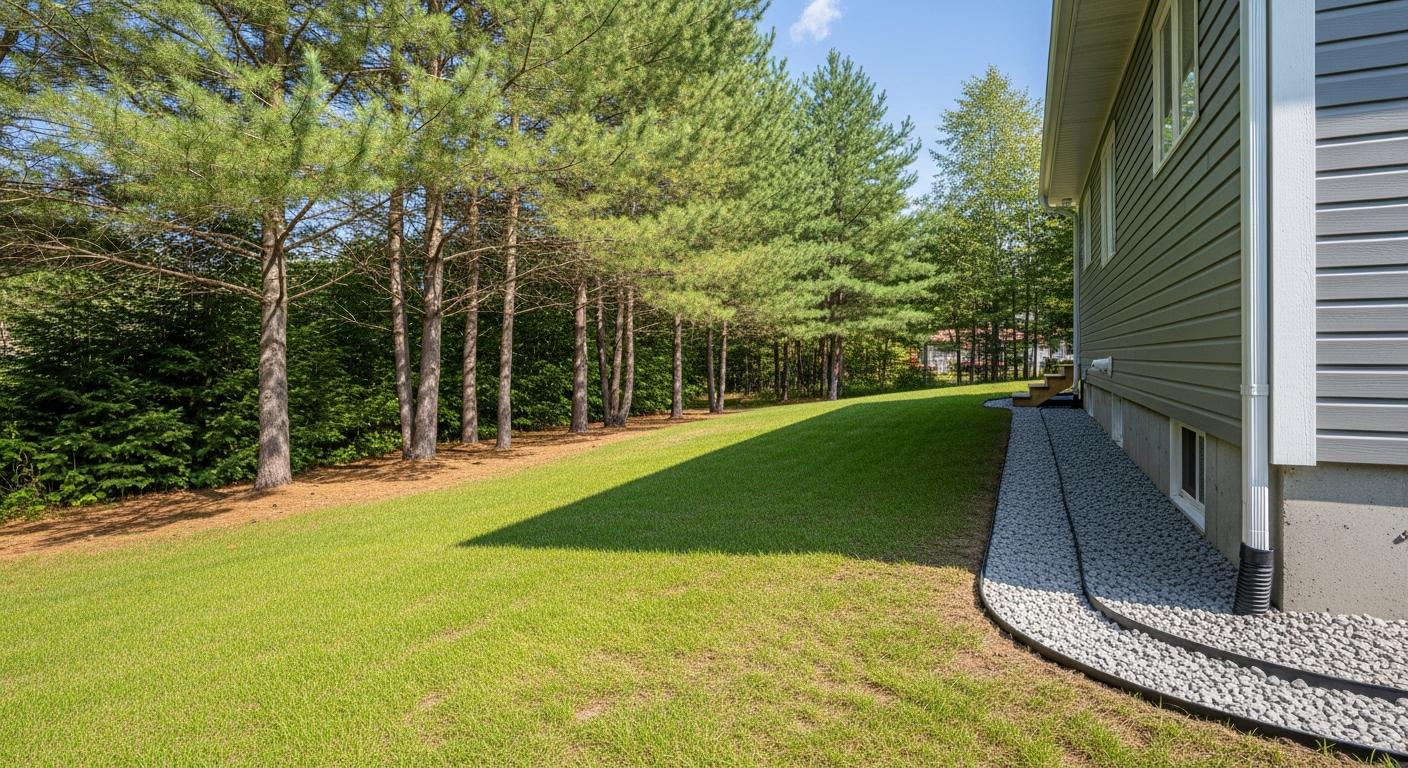
- Downhill of nothing important. Meltwater runs downhill. The ideal pile sits on the low side of the property, with the slope carrying water toward a ditch, swale or drain and away from buildings, doors and walkways.
- Near, but not on, a drain. You want melt to reach a working outlet. You do not want the pile sitting on the grate itself.
- Reachable all winter. A loader or truck needs to get to the pile to push it back, stack it neatly or haul it away. A spot behind a row of parked cars is not a storage spot.
- Sunny and out of the wind. The Lake Simcoe Region Conservation Authority's parking lot design guidelines recommend piles in open, south-facing spots so they melt faster, and placed so the prevailing wind does not blow them back across the lot.
- A short push. The same guidelines warn against long plow routes, which pack snow down and bond it to the pavement. Several smaller storage spots around the edge often beat one far corner.
On most plazas we would rather give up two or three stalls at the edge of the lot for the season than squeeze snow onto the landscaped islands. The stalls come back in spring. A dead tree does not. Paint or sign those stalls as snow storage so nobody parks there in December.
Put it on the site map
Every commercial property should have a simple site map attached to its snow contract, and the storage areas should be signed on site as well. The LSRCA guidelines point out that signs matter most when you change contractors, because the new crew has no memory of last year. Mark the storage areas, the drains and catch basins, the hydrants, the fire route, the accessible spaces, the curbs and stone edges that are easy to hit under snow, and the areas that are off-limits. Hand it to the contractor, keep a copy with your property file, and update it when anything changes on site. If you are still comparing contractors, our guide to choosing a commercial snow removal contractor in Midland covers what else that contract should include.
Field drawing 17 · Snow storage
Decide where the snow goes before it falls
A site map like this belongs in every commercial snow contract.
Swipe to see the full drawing →
- Store snow on the low corner. Pick low-value ground on the downhill side, with no plantings, that a loader can reach all winter.
- Near the drain, not on it. Meltwater should reach a working catch basin. A pile sitting on the grate floods the lot.
- Keep hydrants clear. Midland By-law 2025-53 bans snow on or immediately next to a fire hydrant, or anywhere that blocks access to it.
- Keep the fire route open. The by-law also bans piling snow in a fire route or an accessible space, on private property too.
- Clear accessible stalls first. Put them and the path to the entrance at the top of the priority order.
- Never on plantings. Salty snow piled on beds, islands and tree roots crushes and poisons them, and shows up as a spring repair bill.
- Keep exits low. Piles at the corners of an exit block drivers' view of the sidewalk and street. When storage fills, haul it off site.
Where should snow never go?
Some locations are bad ideas. A few are against the by-law.
What Midland's by-law says
The Town of Midland's Snow Removal By-law 2025-53, which replaced the older 2009-69 by-law, regulates how snow is removed and piled on both public and private property. In plain terms, it says you cannot put snow:
- on a road, roadway or sidewalk, or on Town property or a neighbour's land;
- on a boulevard that is not adjacent to your own property;
- on a boulevard where it blocks a motorist's line of sight;
- on or right beside a fire hydrant;
- where it blocks drainage to a Town drain or sewer;
- in an accessible parking space or a fire route, on private or Town property. This one carries a $500 set fine, compared with $300 for most other offences.
The Town keeps a plain-language summary on its snow removal by-law page. Check it before the season starts. In Penetanguishene, the Town's traffic and parking by-law treats snow on a roadway as obstructing the highway and bans snow on boulevards that do not adjoin your property. It also requires owners to keep designated private fire routes clear of snow and ice.
What a landscaper would add to that list
The by-law covers safety. We would add the things that cost money in spring:
- Planting beds and shrubs. The weight snaps branches, and the salt in plowed snow soaks into the soil as it melts. Evergreens brown from the needle tip back, and deciduous shrubs may not leaf out at all.
- Trees and their root zones. A tree's roots spread well past the trunk. A salty pile over the root zone all winter is one of the most common reasons a healthy parking-lot tree starts declining. The University of Wisconsin's horticulture extension specifically advises against piling salty snow over sensitive roots.
- Sod and lawn edges. Turf under a pile stays wet, compacted and salty. It is often the last patch to green up, if it does at all.
- Armour stone, retaining walls and stone edging. Plow blades and loader buckets find these under the snow. Big piles also push against walls and freeze into the joints.
- Against the building. Snow piled on a foundation wall melts straight into it.
- Interlock and concrete you care about. Repeated melt and refreeze carrying salt is hard on pavers and concrete walks.
What happens to snow piles in the spring thaw?
Every pile is a slow-release water tank. The 400 cubic metre pile from the example above holds a lot of water, and it lets it go over weeks of mild days and freezing nights. Where that water goes decides whether you get a wet corner or a sheet of ice across the main drive.
If the pile sits uphill of the main drive, melt runs across the pavement during the day and freezes into a sheet of ice by evening. That is a slip hazard right where people walk and drive, and it keeps coming back for as long as the pile lasts. If the pile sits over a catch basin, the grate is blocked when you need it most, and water ponds across the lot. If the pile sits against a building or above a landscaped bed, the melt pushes into foundations, soaks beds and washes salty water through the root zone.
Spring flooding on commercial properties often gets blamed on "a lot of snow this year". Usually it is a lot of snow in the wrong place. Before the thaw starts:
- open the catch basins and drain inlets near the piles and keep them clear;
- cut a channel at the base of a pile if melt is pooling on the wrong side;
- watch the low spots on the lot for refreezing and salt or sand them in the evenings;
- push back or break down piles that are sitting where you do not want the water to go.
Because a slip-and-fall claim on snow or ice in Ontario can arrive weeks after the incident, keep records of thaw-season salting and inspections too. Our post on Ontario's 60-day snow and ice notice rule explains why those logs matter.
How do snow piles affect sightlines and safety?
Tall piles near entrances and exits are a safety problem that grows all winter. A pile that is waist-high in December can be taller than a car by February. Drivers pulling out of a plaza onto King Street or Highway 93 need to see oncoming traffic and pedestrians on the sidewalk. A wall of snow at the corner of the entrance takes that away.
Good rules of thumb for your site map:
- keep piles back from the corners of every entrance and exit;
- keep piles low near drive aisles and pedestrian crossings. Penetanguishene puts a number on it: on a corner lot, snow inside the 6 metre sight triangle cannot be more than 0.7 metres high under section 9(4) of its by-law, and that is a sensible rule for any exit;
- never stack snow where it hides a stop sign, a crosswalk or a building door;
- keep the fire route and hydrant clear all season, not just after the storm.
When should you haul snow off site?
When the storage areas are full and the next storm has nowhere to go. In practice the warning signs are easy to spot: piles creeping into parking stalls, piles getting tall enough to block sightlines, snow edging toward the fire route or accessible spaces, or the operator starting to push onto the landscaped islands because the planned spots are full.
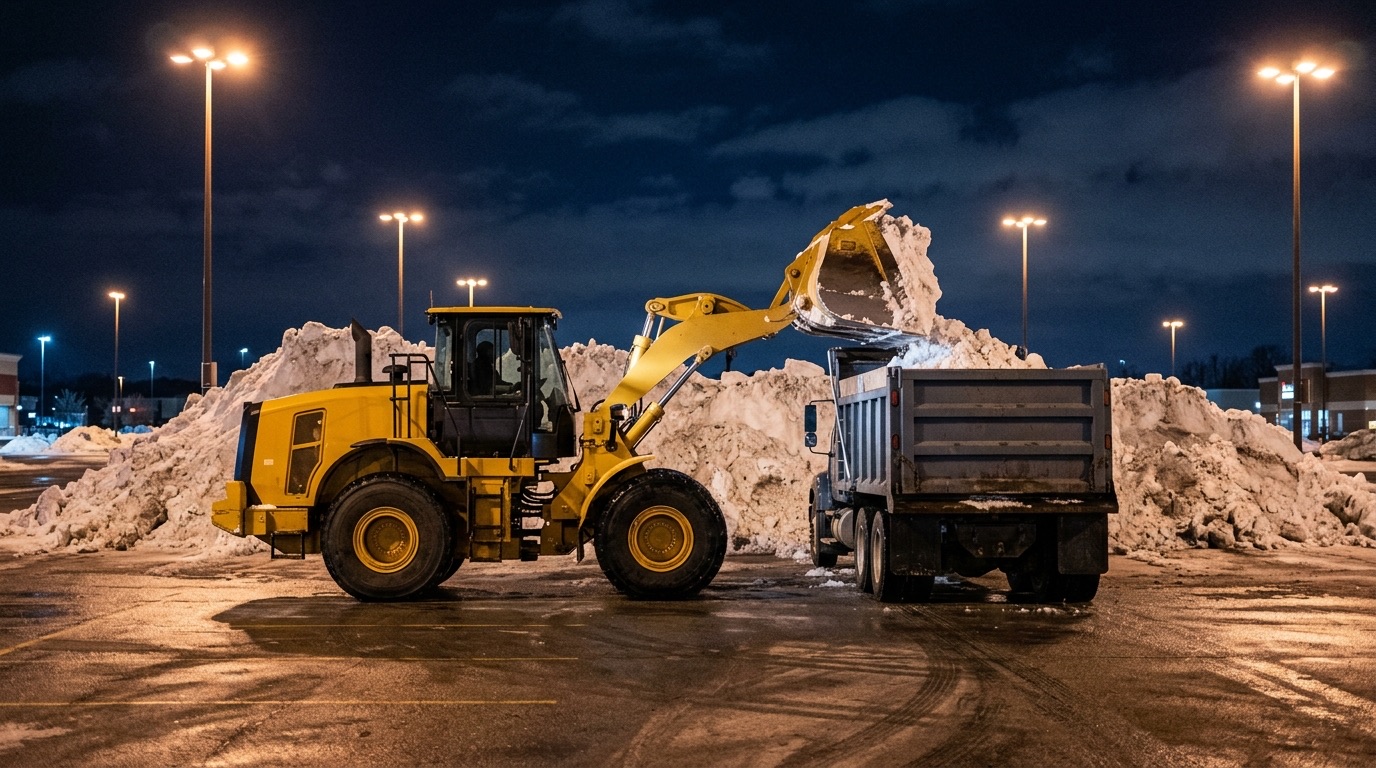
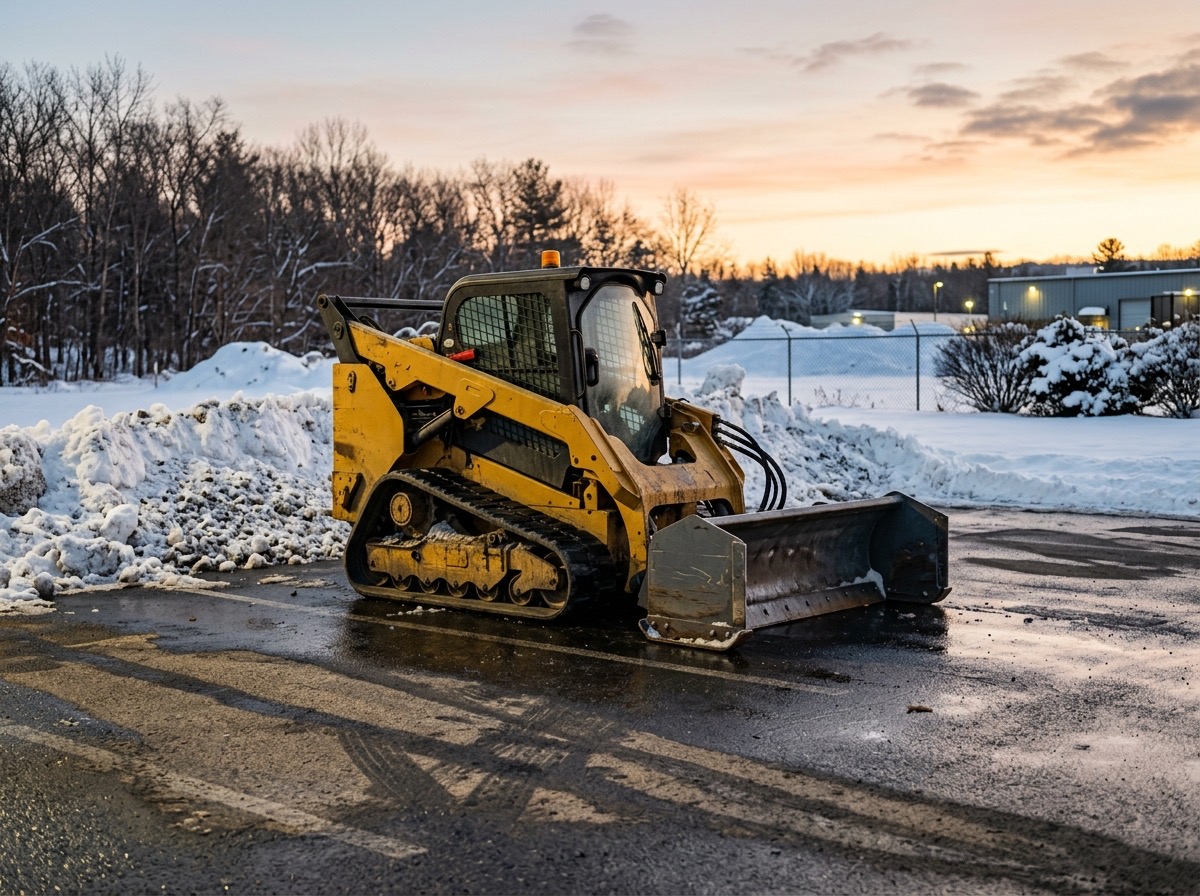
At that point, pushing the pile higher only delays the problem. Snow hauling and removal loads the snow into trucks and takes it off site, which gives you back your storage space and your parking. Downtown and tight lots, like many along King Street in Midland or Main Street in Penetanguishene, often have so little room that hauling is part of the plan from day one. The Town of Penetanguishene runs the same logic on its own streets: its snow removal policy clears banks on Main Street and nearby downtown blocks once they reach about 0.6 metres. Whatever you haul has to go to a legal site. Town lots and boulevards are not one.
Your contract should spell out how hauling is triggered and priced, whether it is included, billed per load or per hour, or quoted when needed. Leaving it vague is how property owners end up with a surprise invoice in a heavy February.
How do grading and drainage make winter easier?
This is the part most snow conversations skip. The best snow storage plan in the world still struggles on a lot that drains badly. If the pavement slopes toward the building, if the only catch basin sits in the middle of the main drive, or if the landscaped islands are higher than the asphalt around them, melt will go where you do not want it no matter where the pile sits.
Fixing that is landscape work, and it is usually done in the warm months:
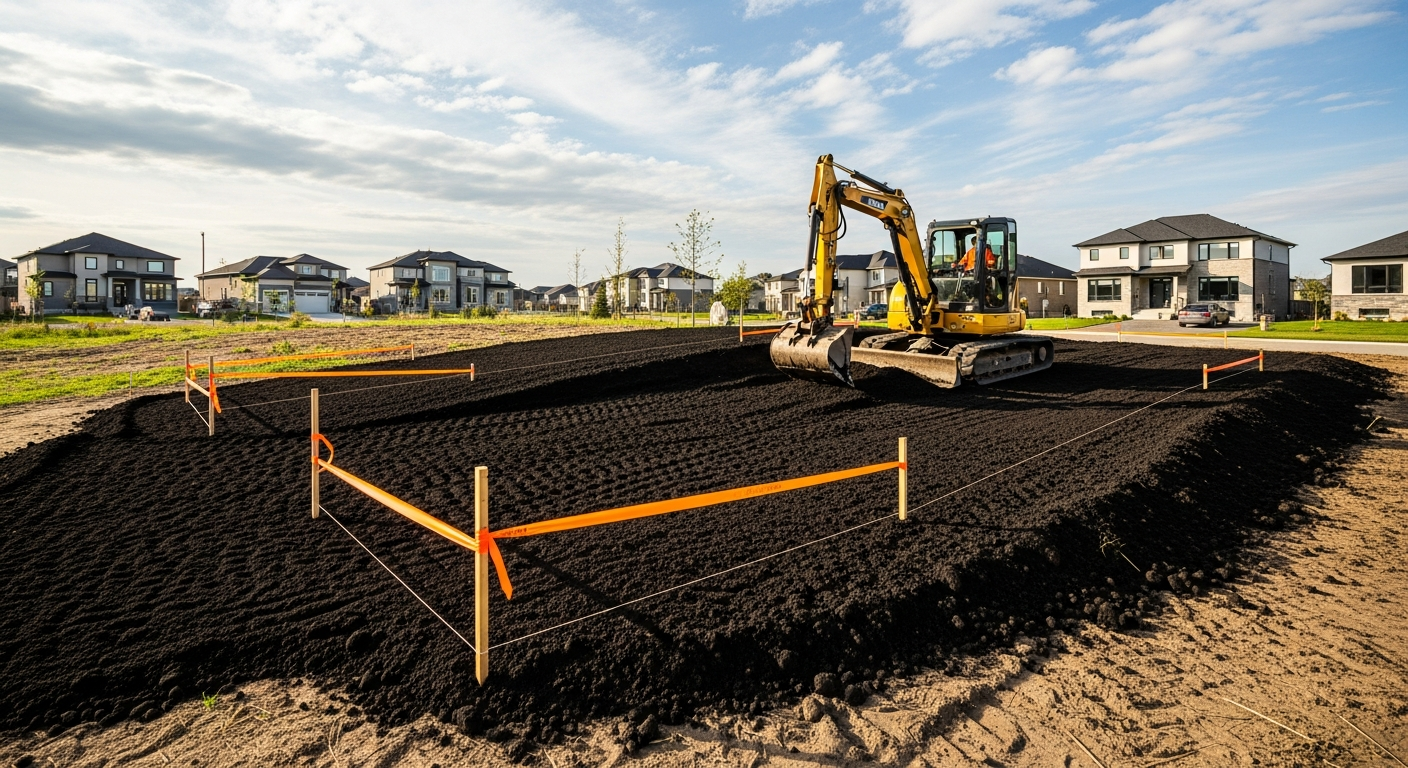
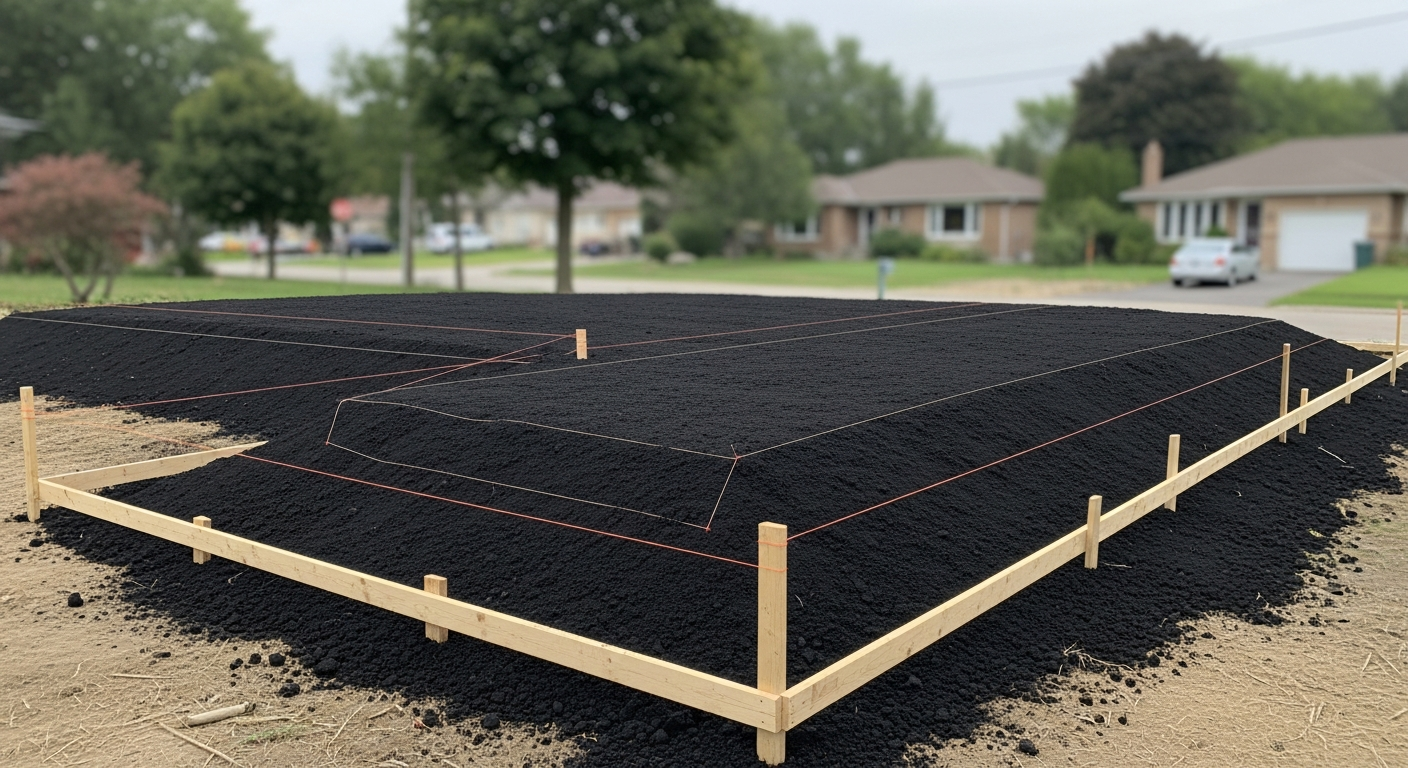
- Lot grading sets the slopes so water runs away from buildings and entrances toward the places that can take it. The LSRCA guidelines recommend parking surfaces at 2 to 4 percent, because flatter pavement forms dips where meltwater pools and freezes. Our lot grading crews do this on residential and commercial sites across Simcoe County.
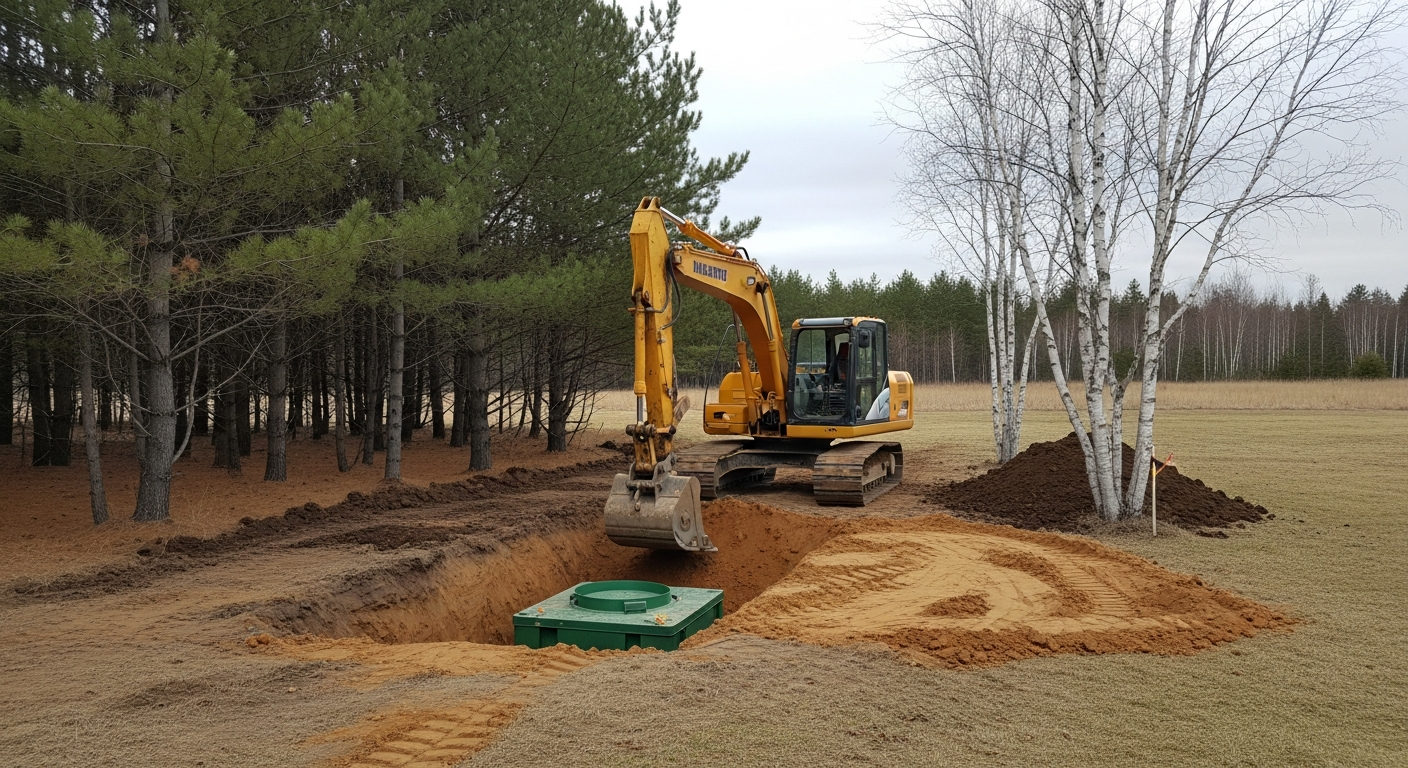
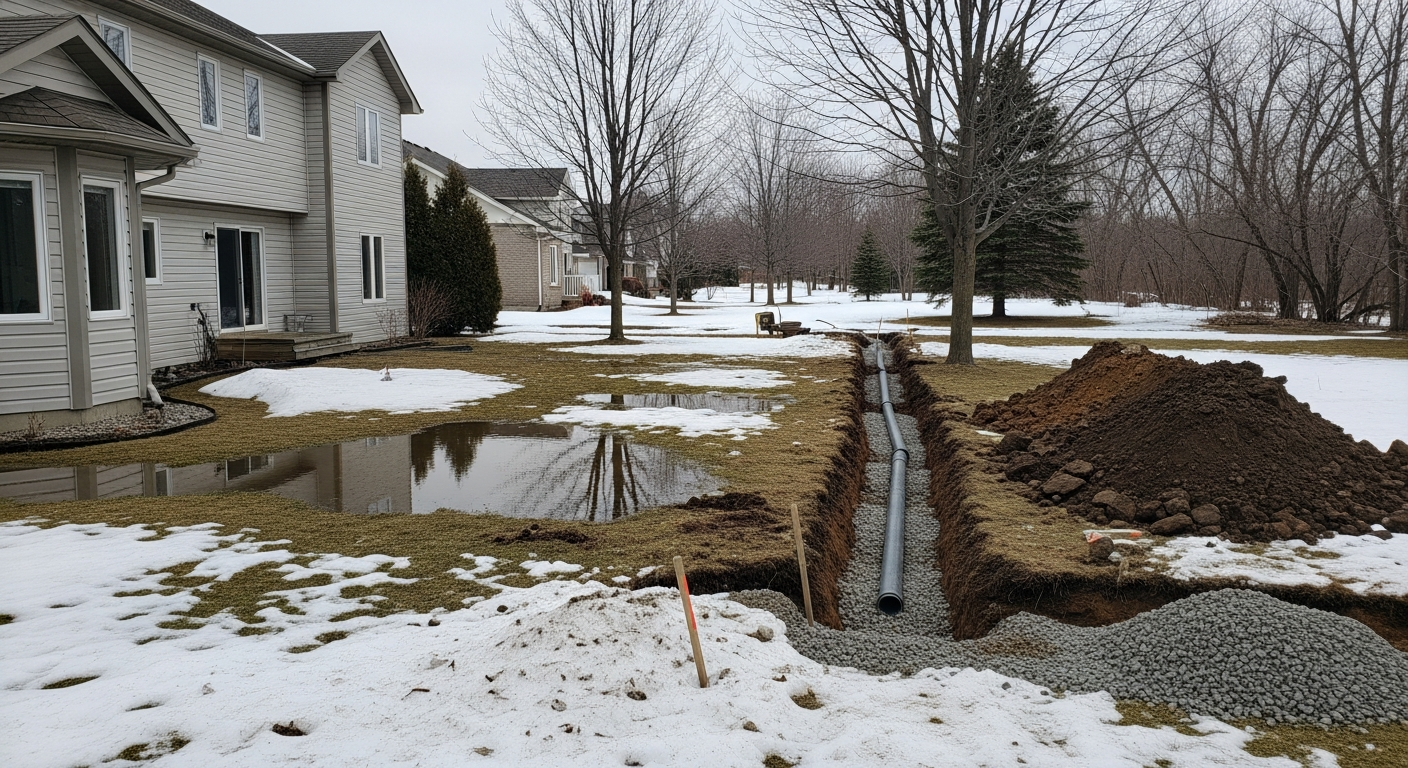
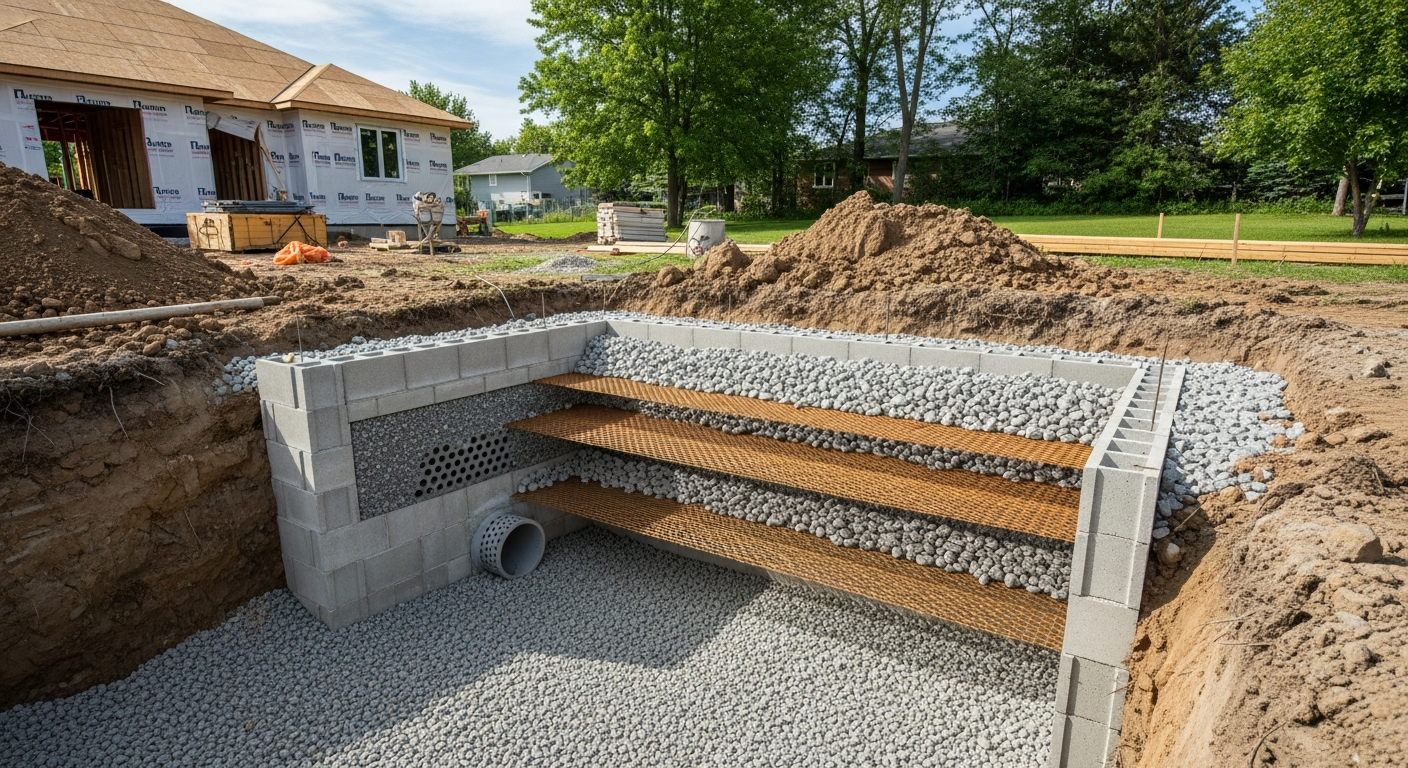
- Drainage work adds swales, catch basins, French drains and outlets so meltwater has a defined path off the property. See our landscape drainage services.
- A designated snow storage pad built on the low side of the site, with an outlet nearby and no plantings around it, turns winter storage into a non-event.
- Salt-tolerant plantings and stone edging along the edges of drive aisles hold up far better than turf and soft beds where plows work.
If you already know your lot floods every March, write that down now. Spring is the time to fix it, and it is much easier to plan with this winter's problem spots fresh in your mind.
Snow storage around Midland, Penetanguishene and Georgian Bay
Every property here has its own puzzle. Plazas along Highway 93 and Hugel Avenue in Midland usually have room at the back of the lot, but the drains are not always where the snow ends up. Older commercial buildings on King Street and Main Street in Penetanguishene have tight lots with little or no storage at all, which makes hauling a regular line in the budget. Waterfront properties near Midland Bay, Penetang Bay, Victoria Harbour and Port McNicoll often slope toward the water, so melt from a badly placed pile runs straight across lawns and gardens toward the shoreline. Rural sites in Tiny and Tay townships along Highway 12 have more space but longer driveways and more landscaped edges to protect.
Plan your snow storage with a crew that built the landscape
We build landscapes around here, so we know where the edges are. When we walk a site for commercial snow removal or parking lot snow removal, we mark storage areas, drains, stone edges and planting beds on a site map before the first push, and the same people come back in spring to look after the landscape.
Ready to plan this winter properly? Request a snow removal quote and we will book a pre-season site walk and put together a written proposal, storage plan included.
Plan your snow contract before the first squall.
We walk your site, map where the snow goes and send a written proposal. Plazas, offices, condos, churches and industrial yards.
Forty-Five Scapes did an amazing job on my property. I started with such a mess, mud and weeds and poor grading. I met with Mark and he put my mind at ease. He took my wants and needs and budget and created a vision. The crew was always on time and respectful and the end product was amazing. I look forward to many years with my amazing outdoor space.
Frequently asked questions
On low-value ground at the edge of the lot, downhill of traffic and just uphill of a working drain, so melt has a short path to an outlet and never crosses walkways. Open, south-facing spots melt faster. Keep piles off catch basins, beds, trees, sod and stone, and away from hydrants, fire routes, accessible spaces and the corners of entrances.
Work it out from your paved area. Each centimetre of snow on 1,000 square metres is 10 cubic metres, so a 20 cm squall on a 2,000 square metre lot makes about 400 cubic metres before plowing compacts it. If your marked storage areas cannot hold a few storms like that, build hauling into the contract from the start.
No. Midland's Snow Removal By-law 2025-53 bans snow in accessible parking spaces and fire routes on private or Town property, with a $500 set fine. Most other snow offences, such as snow on a hydrant, a Town drain, the road or a neighbour's land, carry a $300 set fine. Check the Town's by-law page each season for changes.
A large pile releases its water slowly over weeks of thaw. If it sits uphill of a drive aisle, on a catch basin or against a building, melt pools, refreezes or soaks into foundations and beds. Placing piles on the downhill side near a clear drain, and grading pavement at 2 to 4 percent in the warm months, prevents most thaw-season flooding.