Fountains, ponds, waterfalls, streams and pondless features give a commercial property a focal point and the sound of moving water. In Ontario, a commercial water feature also needs safe shallow edges for the public, grading and a drain outlet so runoff and overflow go somewhere planned, and a maintenance plan that includes fall winterizing and spring start-up.
Key takeaways
A commercial water feature works when it suits the site, is safe for the public, and can be maintained and shut down for winter without fuss. Fountains, ponds, waterfalls and streams all give a business entrance, courtyard or patio a focal point and the sound of moving water, and in Ontario every one of them needs a plan for drainage, freeze-up and upkeep. At Forty Five Scapes, we design and build water features as part of commercial landscaping projects across Midland, Collingwood, Wasaga Beach and the Muskoka region, working them into the wider landscape design. This post covers the types available, design considerations, the drainage behind a feature that lasts, and what to plan for the coming season.
The role of water features in commercial landscaping
Water features are more than decoration. On a commercial property they do several jobs:
- Visual focal point: A fountain or waterfall draws the eye to an entrance, patio or courtyard.
- Sound: Moving water masks traffic and HVAC noise, which makes seating areas more comfortable for clients, customers and employees.
- Habitat: Planted ponds and streams can support birds, pollinators and amphibians.
- Property appeal: A well-kept feature adds to curb appeal, which matters for retail, hospitality and leased space.
- Brand image: A thoughtfully designed and maintained feature shows attention to detail.
Types of water features for commercial landscapes
There are several types of water features suited to commercial properties, each with its own look and maintenance needs.
1. Fountains
Fountains can be customized to fit almost any design, from simple, modern designs to classical styles.
- Jet Fountains: Water jets that create dynamic displays, often set flush with paving.
- Tiered Fountains: Multiple levels or tiers that add height and depth.
- Wall Fountains: Built into building or garden walls, useful where ground space is tight.
2. Ponds
Ponds add a natural, calm element to commercial landscapes and can support biodiversity.
- Koi Ponds: Colourful koi add interest, but they need enough depth to overwinter or must be moved indoors, plus filtration and regular care.
- Natural Ponds: Planted to blend with the surrounding landscape.
- Reflecting Ponds: Shallow, still pools designed for reflection, often paired with surrounding greenery.
3. Waterfalls
Waterfalls add sound and movement to the landscape.
- Freestanding Waterfalls: Stand-alone structures that serve as focal points.
- Integrated Waterfalls: Built into slopes, walls or existing landscape features.
- Rock Waterfalls: Natural stone stacked to look like a natural outcrop.
4. Streams and brooks
Built streams and brooks mimic natural waterways and add movement and continuity to a landscape.
- Meandering Streams: Follow a winding path for a relaxed, natural flow.
- Rock-lined Streams: Use rocks and boulders for a rugged, authentic look.
- Edging Streams: Guide water along specific paths, tying the layout together.
5. Pondless features
A pondless waterfall or bubbling stone recirculates water from a buried reservoir filled with stone, so there is no open pool. For commercial sites with public access, it gives the sound and movement of water with far less standing water, simpler winter shutdown and lower drowning risk.
Design considerations for commercial water features
A water feature should add to the property, not create a maintenance or safety problem. Consider these factors:
1. Location and placement
- Visibility: Position water features where visitors and passersby can see them.
- Functionality: Make sure water features work with walkways, seating areas and entry points, and that spray or splash does not reach paving where it can freeze.
- Safety: In high-traffic areas, keep open water shallow, edges visible and surfaces slip-resistant. Deeper water needs barriers.
2. Size and scale
- Proportion: Match the feature to the size of the space and the building.
- Impact: Aim for a clear focal point without overwhelming the surrounding landscape.
3. Material selection
- Durability: Choose materials that stand up to freeze-thaw cycles and road salt, such as natural stone, frost-rated concrete and stainless or bronze fittings.
- Aesthetics: Choose materials that complement the architecture and the overall landscape design.
4. Maintenance and sustainability
- Ease of Maintenance: Keep pumps, filters and valves in accessible vaults for cleaning and repairs.
- Sustainable Practices: Use recirculating pumps, efficient LED lighting and automatic top-up valves sized to the feature, so it doesn't run on fresh water.
5. Integration with landscaping elements
- Cohesive Design: Make the water feature part of the surrounding planting and hardscape rather than an add-on.
- Plant Selection: Use plants suited to wet edges and to the local hardiness zone.
6. Rules and safety
Check local rules before you design. In Midland, the Pool Enclosure By-law (2026-27) applies to outdoor pools that can hold water deeper than 0.6 m and are meant for bathing or swimming; ponds built for aesthetic, landscape or stormwater purposes are excluded from the pool definition. Even so, a deep pond next to a parking lot or patio is a liability, so most commercial features keep open water shallow. Larger features may also need a building permit for structures and electrical, and a licensed electrician for pumps and lighting.
Drainage and grading around a water feature
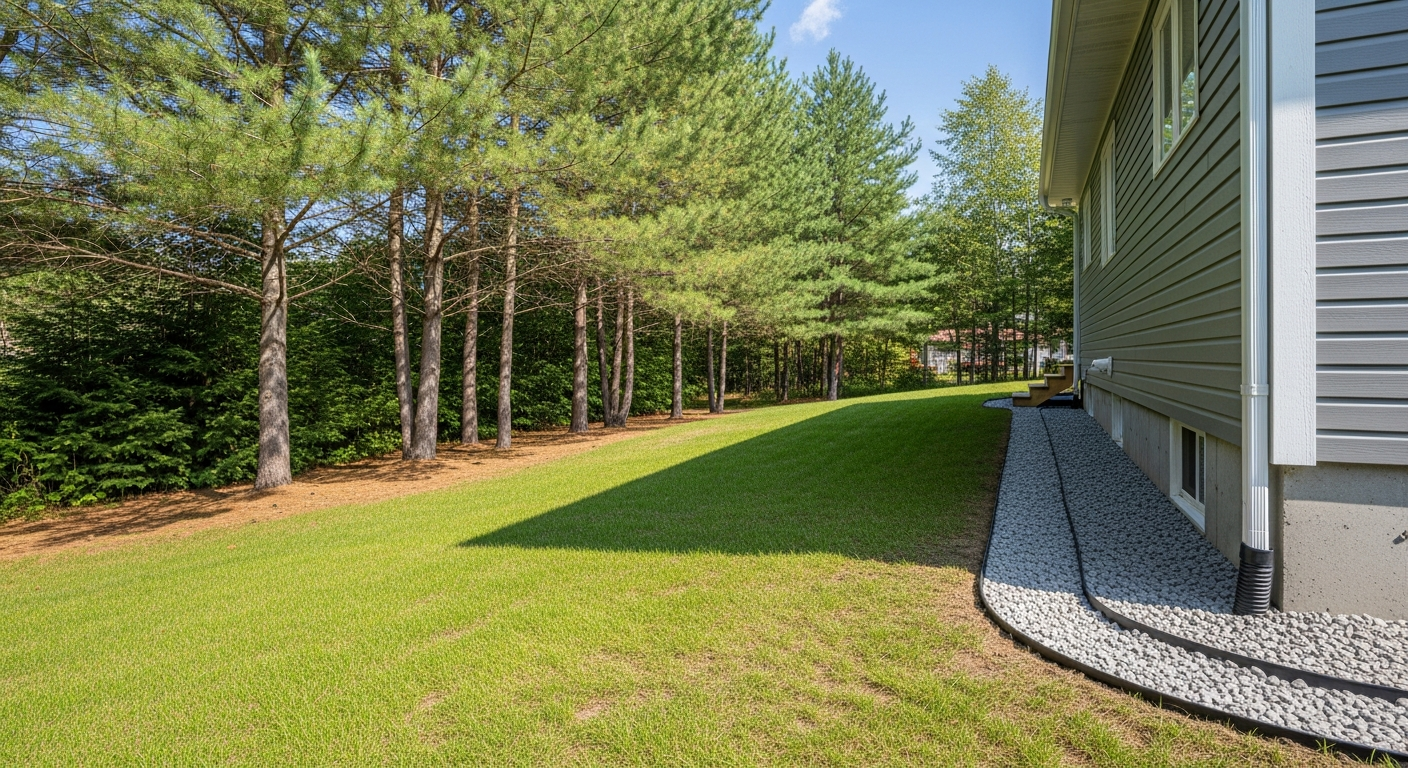
The part of a water feature nobody sees decides whether it lasts. Surface runoff from parking lots and roofs should never drain into a fountain or pond, because it carries silt, salt and oil that cloud the water and clog pumps. The ground around the feature should be graded so runoff moves away from it and away from buildings. The Town of Midland's lot grading standards call for grass and planted areas to fall at least 2% away from buildings and hard surfaces at least 1%, and swales to be at least 150 mm deep with a 2% minimum grade.
Field drawing 04 · Lot grading
Grade every lot away from the house
These are the Town of Midland's minimums for lot grading plans. Most neighbouring towns use similar numbers.
Swipe to see the full drawing →
- Rear apron. At least 5 m of rear yard graded between 2% and 5% away from the house.
- Softscape fall. Grass and planting beds fall at least 2% away from every building. Hard surfaces fall at least 1%.
- Swale depth. Swales sit inside the lot, at least 150 mm deep, and run at a 2% minimum along their length.
- Side slopes. No steeper than 3:1 so they can be mowed and don't erode.
Every feature also needs a place for its own water to go. Overflow during heavy rain and the full drain-down each fall should run to a defined outlet, not across a walkway or into a neighbour's lot. On many commercial sites that outlet is a French drain or a connection to the site's storm system, with approval where a municipal connection is involved.
A French drain built for this job uses perforated pipe set holes-down in clear stone, wrapped in non-woven filter fabric, with at least 1% fall the whole way to a daylight outlet, dry well or approved storm connection. Combined with good grading, it keeps the feature's surroundings dry and prevents frost heave around the basin.
Field drawing 05 · Yard drainage
A French drain only works if it keeps falling
Wrap the stone, point the holes down and give the water a real exit. Depth matters less than continuous fall.
Swipe to see the full drawing →
- Non-woven filter fabric. Line the trench and wrap it over the stone so silt can't clog the drain.
- Perforated pipe, holes down. Bed it on a few centimetres of clear stone so water rises into the holes.
- Clear stone only. Washed stone with no fines. Crusher run with fines will plug.
- Cap with topsoil and sod. Or finish with decorative stone if the drain also catches surface water.
- Fall and outlet. At least 1% fall the whole way to a daylight outlet, dry well or approved storm connection. A drain with no exit is a buried bathtub.
If the property has broader drainage problems, such as ponding in the parking lot or wet planting beds, fix them in the same project. Our commercial landscape drainage guide covers site drainage in more detail.
Winterizing a commercial water feature in Ontario
In Simcoe County and Muskoka, most commercial water features run from spring to mid-fall. Before freeze-up, the pump is pulled or drained, lines are blown out, the basin is cleaned and partly or fully drained, and lighting is checked. Features in public areas are often covered or filled with decorative stone over winter so the empty basin is not a trip hazard. Spring start-up reverses the process and includes a check for frost damage to liners, joints and fittings. Building winterizing into the maintenance contract from the start avoids cracked pumps and pipes.
Benefits of incorporating water features in commercial landscapes
Water features offer several benefits for a commercial landscape:
1. Visual appeal
Water features give a property a focal point and make it more attractive to clients, customers and employees.
2. Improved atmosphere
The sound and movement of water make outdoor seating and entrances more pleasant, and help mask traffic noise.
3. Property appeal
A well-built, well-maintained water feature adds to curb appeal, which supports leasing and resale. A neglected one does the opposite, so budget for maintenance.
4. Habitat value
Planted ponds and streams can provide habitat for birds, pollinators and amphibians, especially when native plants are used along the edges.
5. Brand image
A well-designed water feature reflects attention to detail and supports the business's image.
6. Attracting customers and clients
An inviting outdoor space can encourage visitors to stay longer, which matters for restaurants, hotels and retail centres.
Planning a 2027 commercial water feature
A water feature that is running for the 2027 season is usually designed the winter before. Excavation and basin work can only start once the frost is out and the ground has dried, which in Simcoe County typically means late April or May, and commercial sites often have to schedule around tenants, deliveries and parking. Getting design and approvals done over the winter keeps spring construction short.
Use the off-season to settle the type of feature, where its pump vault and electrical service will go, and where its overflow and drain-down water will end up. If the site's grading or drainage is already a problem, fix it as part of the same project. For public spaces, consider pondless features or shallow basins that are easier to shut down and safer around foot traffic.
- Pick the location with visibility, electrical access and drainage in mind.
- Confirm permits for structures, electrical and any storm connection before spring.
- Write maintenance and winterizing into the contract from the start.
- Coordinate with other site work such as paving, lighting and planting.
Why choose Forty Five Scapes for your commercial water features?
At Forty Five Scapes, we design, build and maintain water features for commercial properties in the Midland, Collingwood, Wasaga Beach and Muskoka areas. Our team handles landscape design, construction and maintenance, so the feature, the grading and the drainage around it are planned together. Here is what we bring to water feature projects:
- Customized Design: We tailor each water feature to the property, its use and its brand.
- Experienced Crews: Our landscapers design, install and maintain features that are practical as well as attractive.
- Durable Materials: We use materials chosen for freeze-thaw durability and low maintenance.
- Sustainable Practices: We use recirculating pumps, efficient lighting and sustainable materials.
- Full Service: From consultation and design to installation, seasonal start-up, winterizing and ongoing maintenance.
- Close Communication: We work with property managers and owners throughout the process.
Frequently asked questions
How much maintenance does a commercial water feature need?
Expect weekly checks during the season for debris, water level and pump function, periodic filter cleaning, and water treatment to control algae. Spring start-up and fall winterizing are the two biggest visits each year. Pondless features and simple fountains need the least.
Do commercial water features need to be shut down in winter?
In Ontario, most outdoor features are drained and shut down before freeze-up to protect pumps, pipes and basins. Some larger features run with heaters or are designed to freeze safely, but that adds cost and needs specialist design.
Does a pond on a commercial property need a fence?
In Midland, the Pool Enclosure By-law excludes ponds used for aesthetic, landscape or stormwater purposes from its definition of a pool, so a decorative pond is not automatically subject to pool fencing. Owners still have a duty of care to visitors, so deep open water in public areas should be avoided or protected.
Where does the water go when a feature overflows or is drained?
It should go to a planned outlet: a French drain, dry well, daylight outlet or approved storm connection. Draining onto paving or a neighbouring property causes ice, erosion and disputes.
Conclusion
A water feature can give a commercial landscape a focal point, a calmer atmosphere and better curb appeal, provided it is sized for the site, safe around the public, properly drained and maintained every season. At Forty Five Scapes, we design and maintain water features for commercial properties in Midland, Collingwood, Wasaga Beach and the Muskoka region.
Planning a water feature for your commercial property? Contact Forty Five Scapes today to talk about the site, the type of feature that suits it, and how it will be built and maintained.
Planning a project this season?
We’ll walk the site, scope it properly and give you a straight price.
Mark and Matt are amazing. Not only do they do high-quality work, but they are also collaborative every step of the way. They are also great at problem-solving for unforeseen issues, or if you are just stuck on what to do in a certain area. I highly recommend Forty-Five Scapes for your landscaping needs.
Frequently asked questions