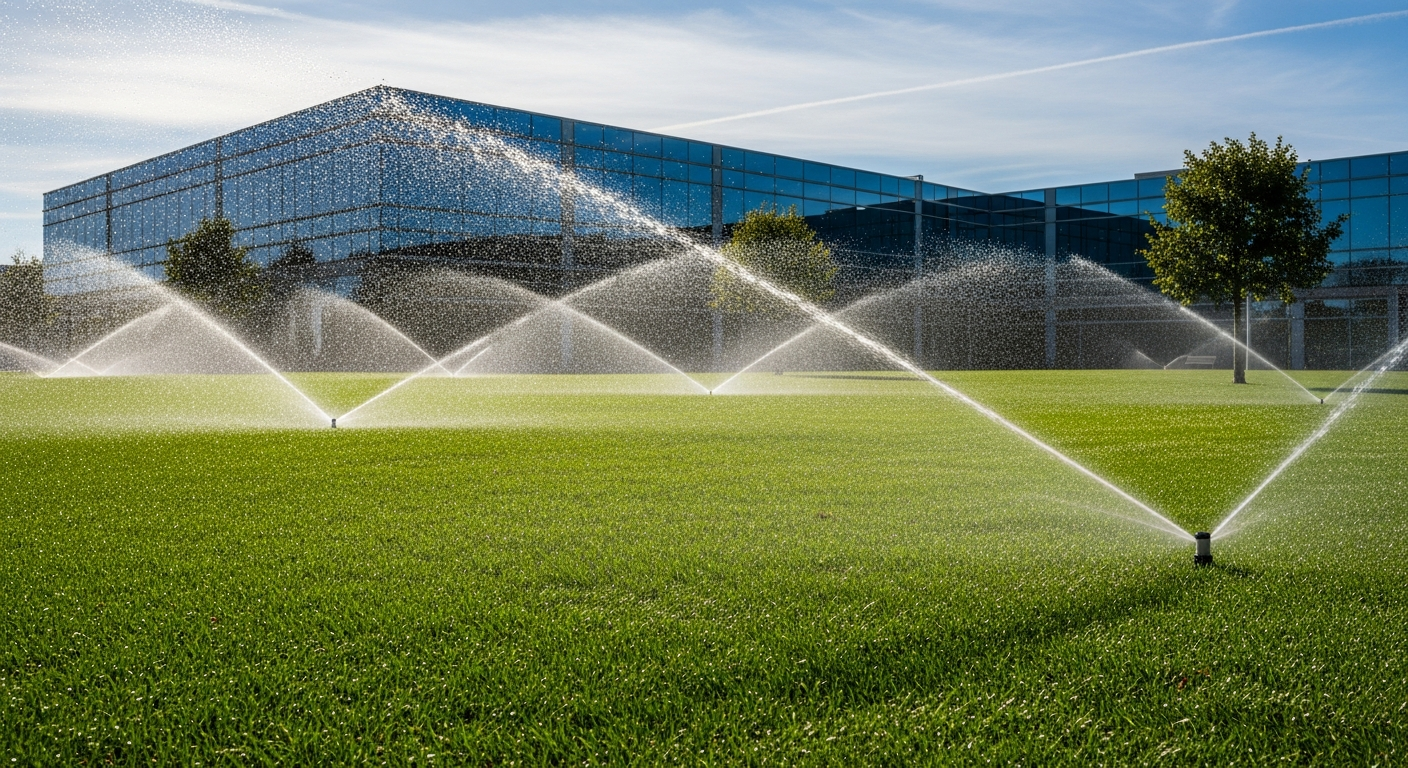
An efficient commercial irrigation system uses zoned sprinklers for turf and drip for beds, a weather- or moisture-based controller and a backflow preventer, all designed from a measured site plan. In Ontario it should follow local watering by-laws, have its backflow device tested where the municipality requires it, and be blown out before the first hard freeze each fall.
Key takeaways
A good irrigation system for a commercial property is a zoned network of sprinklers for turf and drip lines for beds and trees, run by a weather- or moisture-aware controller and protected by a backflow preventer. It should be designed from a measured site plan, set up to follow local watering rules, started up each spring and blown out each fall before freeze-up. Done that way, it keeps an office, retail or multi-residential property green while using less water than hand-set timers and hoses.
At Forty Five Scapes, we plan irrigation as part of our commercial landscaping work around Midland, Penetanguishene and Georgian Bay. This post covers design best practices, the Ontario rules that affect commercial systems, maintenance through the seasons, and what drives the cost.
The Importance of Efficient Irrigation Systems
An effective irrigation system is the backbone of a thriving commercial landscape. Here's why investing in a high-quality irrigation system is crucial:
- Water Conservation: Efficient irrigation systems minimize water waste by delivering the precise amount of water needed for each plant, reducing overall water consumption.
- Healthier Plants: Proper watering ensures that plants receive consistent moisture, promoting robust growth and reducing the risk of diseases and pests.
- Cost Savings: By optimizing water usage, businesses can significantly reduce their water bills and decrease maintenance costs associated with overwatering or underwatering.
- Environmental Responsibility: Sustainable irrigation practices contribute to environmental conservation efforts, aligning your business with green initiatives and responsible resource management.
- Enhanced Curb Appeal: A well-irrigated landscape remains attractive and inviting year-round, making a positive impression on clients, visitors, and employees.
Best Practices for Designing Efficient Irrigation Systems
Designing an efficient irrigation system for large commercial landscapes involves careful planning and the implementation of best practices to ensure optimal performance and sustainability. Here are some essential strategies:
1. Comprehensive Site Assessment
Before designing an irrigation system, conduct a thorough assessment of the site to understand its unique requirements.
- Soil Analysis: Determine soil types and drainage patterns to select appropriate irrigation methods and schedules.
- Plant Selection: Identify the types of plants and their specific water needs to tailor the irrigation system accordingly.
- Sunlight Exposure: Analyze sunlight patterns to ensure that plants receive adequate water without excess evaporation.
- Topography: Consider the landscape's contours and slopes to design an irrigation system that effectively covers all areas.
- Water Source and Pressure: Confirm whether the system will run on municipal water or a well, the service size, and the static and working pressure at the connection. Pressure and flow decide how many heads each zone can run at once.
All of that starts with measurements. The designer needs the square metres of each turf and bed area, the shape of odd corners and islands, and the elevation change across the site. Water pressure drops by roughly 9.8 kPa (about 1.4 psi) for every metre a pipe climbs, so a sloped site with heads at the top and bottom needs pressure-regulated heads or zones split by elevation, and low heads need check valves so the lines don't drain out through them after every cycle.
Field drawing 01 · Measuring
Measure area, slope and volume before you order
Three numbers drive every landscape quote: square metres, fall and cubic metres.
Swipe to see the full drawing →
- Split odd shapes. Break the yard into rectangles, triangles and circle segments, measure each, then add them.
- Level a string line. Stretch it between two stakes and set a line level in the middle so the string is dead level.
- Measure down at each stake. The difference is the rise. Divide by the run between stakes and multiply by 100 for percent.
- Volume = area × depth. Convert depth to metres first. Tell the supplier the compacted depth you need.
- Check against the standard. In Midland, grass must fall at least 2% away from buildings and hard surfaces at least 1%.
A measured plan also lets you compare bids fairly, because every contractor is pricing the same zones, head counts and pipe runs.
2. Zoning and Customization
Segment the landscape into different zones based on plant types, water requirements, and environmental conditions.
- Customized Zones: Create separate zones for lawns, flower beds, shrubs, and trees, allowing for precise control over water distribution.
- Smart Controllers: Implement smart irrigation controllers that adjust watering schedules based on weather data and soil moisture levels, enhancing efficiency.
3. Drip Irrigation and Sprinkler Systems
Choose the right irrigation methods to match the landscape's needs and optimize water usage.
- Drip Irrigation: Ideal for flower beds, shrubs, and trees, drip irrigation delivers water directly to the plant roots, minimizing evaporation and runoff.
- Sprinkler Systems: Suitable for large grassy areas, sprinkler systems provide uniform coverage and can be adjusted for different zones.
4. Efficient Irrigation Scheduling
Develop a watering schedule that aligns with the landscape's natural rhythms and minimizes water waste.
- Early Morning Watering: Schedule watering sessions early in the morning to reduce evaporation and allow plants to absorb moisture before the heat of the day. Program the controller to match local rules. In Midland, for example, the Water Conservation By-law allows outdoor watering only on odd or even days matching the street address, between 5:00 and 10:00 a.m. and 7:00 and 9:00 p.m., and the Town can tighten that during a watering advisory or ban.
- Seasonal Adjustments: Adjust watering schedules based on seasonal changes, increasing during hot months and reducing during cooler periods.
5. Regular Maintenance and Monitoring
Ensure the irrigation system remains efficient and effective through ongoing maintenance and monitoring.
- Leak Detection: Regularly inspect the system for leaks or broken components to prevent water loss and ensure consistent performance.
- Spray Pattern Checks: Verify that sprinklers are delivering water evenly and adjust as necessary to avoid dry spots or overwatered areas.
- System Upgrades: Invest in system upgrades, such as rain sensors and moisture sensors, to enhance automation and responsiveness to environmental conditions.
6. Sustainable Practices
Incorporate sustainable practices to further enhance the efficiency and environmental impact of your irrigation system.
- Rainwater Harvesting: Collect and utilize rainwater for irrigation, reducing reliance on municipal water sources. Cisterns need filtration and a pump sized for the zones they feed.
- Permeable Paving: Use permeable materials in hardscaping to allow rainwater infiltration, reducing runoff and improving water management.
- Mulching: Apply mulch around plants to retain soil moisture, reduce evaporation, and suppress weed growth, enhancing the effectiveness of the irrigation system.
Maintaining Efficient Irrigation Systems
Proper maintenance is essential to ensure that your irrigation system operates at peak efficiency and extends its lifespan. Here are key maintenance practices:
1. Regular Inspections
Conduct routine inspections to identify and address issues promptly.
- Component Checks: Inspect valves, pipes, sprinklers, and drip emitters for signs of wear, damage, or clogging.
- Coverage Assessment: Ensure that all areas of the landscape are receiving adequate water and adjust sprinklers or drip lines as needed.
2. System Cleaning
Keep the irrigation system clean to prevent blockages and ensure optimal water flow.
- Filter Cleaning: Clean filters regularly to remove debris and prevent clogging of drip emitters and sprinklers.
- Nozzle Maintenance: Remove and clean nozzles to ensure they deliver water uniformly and efficiently.
3. Seasonal Adjustments
Adapt the irrigation system to accommodate seasonal changes and varying plant needs.
- Fall Winterization: Blow out the lines with compressed air and drain or protect the backflow preventer before the first hard freeze, usually in October in Simcoe County.
- Spring Activation: Reconnect and test the system in the spring once hard frost is past, making necessary adjustments to accommodate new growth and changing conditions.
4. Backflow Prevention and Testing
Any irrigation system connected to a drinking water supply needs a backflow preventer so fertilizer, soil and stagnant water can't be drawn back into the building or the municipal main. The Ontario Building Code requires backflow protection on these connections, and many Ontario municipalities have backflow or cross-connection by-laws that require commercial devices to be tested by a certified tester when installed and then every year. Check your municipality's current requirements before you open the system in spring.
5. Technology Integration
Leverage technology to enhance the efficiency and management of your irrigation system.
- Smart Sensors: Install soil moisture sensors and weather-based controllers to automate watering schedules based on real-time data.
- Remote Monitoring: Utilize remote monitoring tools to oversee system performance and make adjustments from anywhere, ensuring timely responses to issues.
Benefits of Professional Irrigation System Design and Maintenance
Working with a professional contractor offers several advantages when managing commercial irrigation systems:
1. Expertise and Experience
An experienced team designs zones, pipe sizes and head spacing around the site's real pressure and flow instead of guessing, which is where most underperforming systems go wrong.
2. Customized Solutions
We provide customized irrigation solutions that align with your property's specific needs, ensuring optimal water usage and landscape health.
3. Advanced Technology
Smart controllers, rain sensors and soil moisture sensors cut run times on wet weeks and are worth specifying on any new commercial system.
4. Comprehensive Services
Design, installation, seasonal start-up and shut-down, and repairs are easier to manage when one contractor knows the system from the start.
5. Cost Efficiency
Efficient design and regular maintenance reduce water consumption and repair calls over the life of the system.
6. Sustainability Commitment
Matching water to plant needs, using drip in beds and choosing drought-tolerant plants all reduce the load on the system.
What affects the cost of a commercial irrigation system?
Commercial irrigation is priced per project rather than per square metre, because the same area can need very different systems. The main cost drivers are the number of zones and heads, the length of mainline and lateral pipe, the water source (a new well or cistern and pump adds a lot), the size of the controller and whether it is a smart or central-control model, the backflow device and its testing, and site conditions such as rock, existing pavement to bore under and slopes. Retrofitting an established property usually costs more than installing during new construction, when trenches are open and sleeves can go under walkways before they are paved.
Why Choose Forty Five Scapes for Your Commercial Irrigation Systems?
Forty Five Scapes is a family-owned design-build landscaping company in Penetanguishene. Here is how we approach irrigation on commercial projects:
- Tailored Designs: We create irrigation systems that are specifically designed to meet the unique requirements of your commercial landscape, ensuring maximum efficiency and effectiveness.
- Coordinated Construction: Irrigation is planned alongside grading, planting and hardscaping, so sleeves and lines go in before surfaces are finished.
- Commercial-Grade Components: We specify components rated for commercial use so the system holds up to daily cycling and winterization.
- Sustainable Practices: Our irrigation solutions are designed with sustainability in mind, promoting water conservation and environmental responsibility.
- Ongoing Support: We handle spring start-up, fall blow-out and repairs so the system is ready each season.
- Clear Documentation: We leave an as-built zone map so maintenance crews and future contractors know where every valve and line runs.
Planning a 2027 commercial irrigation system
The best time to plan irrigation for the 2027 season is over the winter, while the system is shut down. If you already have one, pull the controller history and water bills from 2026, note dry spots and soggy areas, and list any heads or valves that were repaired more than once. Those notes tell a designer whether the system needs tuning, rezoning or replacement.
For new systems, line up the design in December to February so the backflow device, any municipal approvals and the water connection are sorted before ground thaw, usually late April or May in Simcoe County. If you are building or repaving in 2027, add irrigation sleeves under new walks and drive aisles now; it costs little during construction and a lot afterwards. Worth choosing for 2027: weather-based or soil-moisture controllers, drip in all shrub and perennial beds, and zones split by sun exposure and slope rather than by convenience.
- Review 2026 water use and problem zones.
- Confirm your municipality's watering rules and backflow testing requirements.
- Book spring start-up and backflow testing early.
- Coordinate sleeves with any 2027 paving or construction.
Frequently asked questions
Does a commercial irrigation system need a backflow preventer in Ontario?
Yes, if it is connected to a drinking water supply. The Building Code requires backflow protection, and many municipalities require commercial devices to be tested annually by a certified tester.
When should commercial irrigation be winterized?
Before the first hard freeze. In Simcoe County that usually means a compressed-air blow-out in October, with start-up in spring once hard frost has passed.
Drip or sprinklers for commercial landscapes?
Both, in different zones. Sprinklers and rotors suit turf; drip suits beds, shrubs and trees because it puts water at the roots with little evaporation or overspray onto walkways.
Are there watering restrictions for irrigation systems in Midland?
Yes. Midland's Water Conservation By-law applies to permanent irrigation systems as well as hoses: odd or even days by address, between 5:00 and 10:00 a.m. and 7:00 and 9:00 p.m., with stricter limits possible during an advisory or ban.
Talk to us about irrigation on your property
Efficient irrigation systems are essential for maintaining healthy and attractive landscapes in large commercial properties. By investing in well-designed and properly maintained irrigation solutions, businesses can enjoy lush, vibrant landscapes while conserving water and reducing long-term costs.
If you are planning a commercial landscape project in Midland, Penetanguishene or the surrounding area, contact Forty Five Scapes to talk through irrigation as part of the design. For more on how the parts work together, see How Does an Irrigation System Work?
Planning a project this season?
We’ll walk the site, scope it properly and give you a straight price.
Mark and Matt are amazing. Not only do they do high-quality work, but they are also collaborative every step of the way. They are also great at problem-solving for unforeseen issues, or if you are just stuck on what to do in a certain area. I highly recommend Forty-Five Scapes for your landscaping needs.
Frequently asked questions