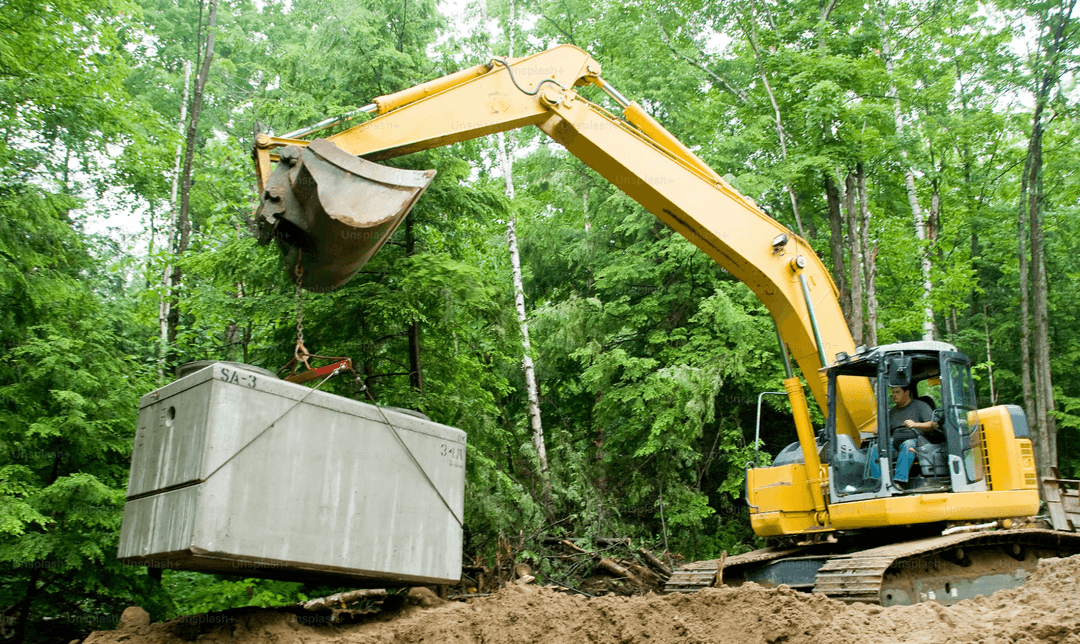
Replacing a septic system in Ontario typically costs $15,000–$35,000 for a conventional leaching-bed system in 2026, averaging roughly $20,000–$28,000. But on a waterfront or constrained cottage lot the realistic range is $30,000–$55,000, and difficult sites can top $65,000. The premium is driven by advanced (Class 4) treatment units, imported fill, limited access and conservation-authority permits. Setbacks also tighten near water — often 30 m for a leaching bed — and a failed grandfathered system usually can't be rebuilt in the same spot.
An old septic sitting 10 m from the lake can run fine for years — until it fails, and then it legally can't go back where it was. Most generic cost guides quote Ontario averages that ignore the near-water premium cottage owners actually pay. Below are real 2026 costs by system type, the near-water rules that drive them, and how to plan before a failure — or a conservation-authority order — makes the decision for you.
We're a design-build company working the Midland, Penetanguishene, Georgian Bay and Muskoka corridor, and we do the site work and field prep for cottage and waterfront septic projects. That means we spend a lot of time on the parts of the job that generic cost pages skip: access, imported fill, staging and the grandfathering trap. The pricing here blends published contractor ranges (cited throughout, and clearly marked as estimates) with what we see on the ground locally.
A full conventional septic replacement typically costs $15,000–$35,000 in Ontario in 2026, averaging roughly $20,000–$28,000, before the extra costs that near-water lots add (Kawartha Septic, 2026). That figure usually covers the tank, a new leaching bed, excavation, pipe and basic restoration on a straightforward lot.
Replacing a septic system in Ontario typically costs $15,000 to $35,000 for a conventional leaching-bed system in 2026, averaging roughly $20,000 to $28,000, according to contractor pricing — though waterfront and constrained cottage lots routinely cost significantly more. Treat every number here as an estimate: the final price depends on your soils, your setbacks and how hard your site is to reach.
That last point is where averages mislead cottage owners. A published Ontario average is built mostly from suburban and rural lots with room to work and good soil. Our local reality — bedrock near surface, tight shoreline setbacks, seasonal roads and long carry distances for equipment and fill — routinely pushes a project past the "average." Two identical houses can carry very different septic prices purely because of what's under and around them. For the full picture on rocky sites specifically, see our guide to septic system options for cottages on rock.
Costs rise with site difficulty: a conventional bed runs $15,000–$28,000, a raised/mound system $18,000–$35,000+, a Class 4 advanced treatment unit $25,000–$45,000+, and a holding tank $12,000–$20,000+ (SepticReplacement.ca; Headwaters Construction, 2026). A Class 4 advanced treatment unit typically adds $8,000–$20,000 over a conventional system.
The table below pulls those ranges together. All figures are contractor estimates for 2026 and vary with soil, access and permit requirements — use them to plan, not to budget to the dollar.
Conventional beds are cheapest wherever soils and setbacks allow them; Class 4 advanced treatment units suit tight and waterfront lots because they clean effluent to a higher standard in a smaller footprint. The trade-off is cost and maintenance: a Class 4 unit adds $8,000–$20,000 up front (SepticReplacement.ca, 2026) and needs annual servicing. If your lot can host a conventional bed at compliant setbacks, that's almost always the better-value path.
Permits, soil testing and system design add roughly $2,000–$6,000+ before a single machine turns up. Soil testing runs $1,000–$2,000, engineered design $600–$3,000, and septic permit fees around $350–$1,200+ (SepticReplacement.ca, 2026). These are unavoidable on a near-water replacement, so build them into your budget from day one rather than treating them as surprises.
Advanced treatment units need annual servicing, typically around $150–$500 per year (Allto Construction, 2025), on top of routine tank pump-outs every few years. A conventional bed has no annual service contract, which is one more reason to keep the system conventional when your site allows it.
Waterfront replacement realistically runs $30,000–$55,000, and difficult sites can exceed $65,000, because tight setbacks force a smaller-footprint Class 4 system, imported fill, engineered design, limited access and a conservation-authority permit (SepticReplacement.ca, 2026). None of those drivers show up in a generic Ontario average.
The near-water premium is mostly a site-work premium — which is the part we handle. On a typical cottage lot the driveway is narrow, the grade is steep and the bed location is a long way from where a truck can actually stop. That means smaller machines, mini-excavator access, more staging and more trips. When the native soil won't pass, clean fill has to be imported and placed — and on a constrained shoreline lot that fill often has to be carried in rather than dumped. Long pipe runs between tank, treatment unit and bed add cost again. It's rarely one big line item; it's a dozen small ones that a flat "Ontario average" never captures. For the regulatory side of these projects, our overview of waterfront septic systems in Ontario goes deeper on the rules.
The Ontario Building Code minimum is commonly cited at 15 m from a water body, but for leaching beds near lakes the effective, enforced minimum is often 30 m, and sensitive watersheds or conservation authorities can require more (Ontario Building Code; SepticReplacement.ca). Tanks generally sit closer than beds — often around 10 m — because they don't discharge to soil the way a bed does.
Ontario's Building Code minimum septic setback from water is commonly cited at 15 metres, but for leaching beds near lakes the effective minimum is often 30 metres, and conservation authorities or sensitive-watershed rules can require even more — a key reason waterfront replacements cost more. We flag this carefully on purpose: the exact figure that applies to your lot depends on the water body, the watershed and your local authority. Always confirm the precise setback against O. Reg. 350/06 (the Building Code) and your health unit or conservation authority before you design or budget. The gap between 15 m and 30 m is often the difference between a bed that fits your lot and one that doesn't — which is exactly what leads to the grandfathering trap below.
A waterfront replacement needs a health-unit or conservation-authority septic permit and, near regulated shorelines and wetlands, a conservation-authority development permit under O. Reg. 41/24 (effective April 1, 2024), plus possibly a municipal building permit — and sequencing errors are the top cause of delay (SepticReplacement.ca). Septic permit fees range from about $350 to $1,200+, soil testing $1,000–$2,000 and design $600–$3,000 (SepticReplacement.ca / Allto Construction, 2025).
Here's the practical wrinkle we see constantly: near water you're often dealing with two or three approval layers at once — the health unit or conservation authority for the septic, the conservation authority again for shoreline development, and sometimes the municipality. Get the order wrong and you wait. Timing matters too. A permit filed in the fall can sit behind the seasonal backlog and push construction into the next year, while a spring application clears faster. Planning the paperwork before you're in a failure emergency keeps you in control of both the schedule and the price. Associations like OOWA and FOCA are good starting points for understanding the process.
Watch for surfacing effluent, sewage odours, slow drains, wet or spongy spots over the bed, or coliform and nitrate spikes in your well water — signs of a biomat-clogged bed past its roughly 30-year life (FOCA). Roughly 25% of Ontario's septic systems are beyond their 30-year design life and about 30% are failing to adequately protect the environment, according to FOCA and OOWA.
Warning signs include surfacing effluent, odours, slow drains, and spongy ground over the leaching bed. The reason we push early planning so hard is money: a system replaced on your schedule gives you time to test soils, choose the best bed location and file permits in the right order. A system replaced under a failure — or under a remediation order — takes those choices away. If your system is anywhere near that 30-year mark, book an assessment now rather than waiting for the first wet spot.
An old system 8–12 m from the water can legally keep operating, but once it fails it usually can't be replaced in the same spot — it must meet current setbacks, sometimes forcing it elsewhere on the lot or into major engineering (SepticReplacement.ca). This is the single most expensive surprise we watch cottage owners walk into.
Failing near-water systems leak phosphorus and nitrogen that fuel algae blooms and can close beaches (Watersheds Canada; FOCA), which is exactly why the rules don't let a failed system return to a non-compliant location. The catch is that your current bed might be sitting in the only easy spot on the lot. When it has to move back to meet a 30 m setback, you can lose usable yard, gain a Class 4 requirement, and add fill and long pipe runs all at once.
Our strongest piece of advice: figure out where a compliant replacement bed could go before the old one fails. Knowing your options in advance keeps you in control of cost, location and timing instead of reacting to an order. Site work and grading are a big part of that planning — if you're weighing the earthwork side, our breakdown of lot grading cost in Ontario is a useful companion, and if you're comparing installers, see the best septic system design and installation companies in Midland.
A conventional replacement typically costs $15,000–$35,000 in 2026 (averaging ~$20,000–$28,000). Waterfront or constrained cottage lots realistically run $30,000–$55,000 and can exceed $65,000 (Kawartha Septic; SepticReplacement.ca, 2026). These are estimates and vary with soil, access and permits.
Tight setbacks force a smaller-footprint Class 4 advanced treatment system (adding $8,000–$20,000), plus imported fill, engineered design, limited access and a conservation-authority permit — pushing waterfront replacements well above conventional costs.
The Building Code minimum is commonly cited at 15 m, but for leaching beds near lakes the effective minimum is often 30 m, and conservation authorities can require more. Confirm the exact figure against O. Reg. 350/06 and your local authority.
It leaks phosphorus, nitrogen and bacteria that fuel algae blooms and can close beaches, may trigger a health-unit remediation order, and can hold up a waterfront sale. A failed near-water system usually can't be rebuilt in its original spot.
Usually not. An old system close to the water can keep operating, but once it fails the replacement must meet current setbacks — often forcing it to a different part of the lot or into major engineering.
The cheapest septic replacement is the one you plan on your own timeline — with soils tested, the best bed location chosen and permits filed in the right order — not the one forced on you by a failure or a conservation-authority order. On cottage and waterfront lots, most of the cost and most of the risk sits in the site work: access, fill, staging, pipe runs and setbacks. That's the part we handle.
If you own near Midland, Penetanguishene, Georgian Bay or Muskoka and your system is getting older, let's look at your lot before the ground tells you it's time. Request a site-work and field-prep estimate and we'll walk the site, flag the setback and access issues early, and help you plan a replacement you control.