To keep water out of a Midland cottage, grade soil at least 2% away from the foundation on lawn areas and 1% on hard surfaces, send downspouts past the backfill, and use swales and French drains with continuous fall to a proper outlet. Rain gardens, permeable paving and a native shoreline buffer handle the rest.
Key takeaways
Introduction to Effective Flood Management
The landscaping that keeps water out of a Midland cottage starts with grading: soil should fall at least 2% away from the foundation on lawn and planted areas and at least 1% on hard surfaces. Add downspouts that discharge well away from the house, swales to carry water around the cottage, French drains with continuous fall to a proper outlet, rain gardens and permeable paving to soak up runoff, and a planted buffer along the shoreline. Together these handle most heavy rain and spring melt.
Midland, Ontario, with its lakes, rivers and Georgian Bay shoreline, is a popular place for cottages. That same water brings the challenge of managing potential flooding. Recognizing the risks and understanding the role of landscaping in flood prevention are foundational steps in safeguarding your property.
Assessing Your Property's Flood Risk
Before implementing any landscaping measures, it's vital to assess your property's specific flood risk. This includes evaluating the terrain, understanding water flow patterns, and identifying areas most vulnerable to water intrusion. Such an assessment will inform your landscaping strategy, ensuring it is both effective and tailored to your property's needs.
The best time to look is during spring thaw or a heavy rain. Note where water pools, where it runs toward the cottage, and whether it comes from your own roof and driveway, from a neighbour's lot or from rising lake water. Check the ground right against the foundation: backfilled soil settles over time and often ends up sloping toward the walls. Find the septic tank and leaching bed too, because drainage must be sent away from them. If your cottage is near the water, ask the municipality whether the lot falls within a mapped floodplain or shoreline hazard area before you plan new work there.
Key Landscaping Strategies for Flood Prevention
Several landscaping strategies can significantly reduce the risk of flooding. Techniques such as grading and sloping can guide water away from your cottage, while rain gardens soak up runoff in a planted bed. Native plants and permeable pavements also help the property absorb excess water.
Grade the ground away from the cottage
Grading does more than any other single fix. The Town of Midland's lot grading standard calls for grass and planting beds to fall at least 2% away from every building and hard surfaces at least 1%, with at least 5 m of rear yard graded between 2% and 5%. Swales, the shallow grassed channels that carry water around a building, should be at least 150 mm deep, run at a 2% minimum, and have side slopes no steeper than 3:1.
Field drawing 04 · Lot grading
Grade every lot away from the house
These are the Town of Midland's minimums for lot grading plans. Most neighbouring towns use similar numbers.
Swipe to see the full drawing →
- Rear apron. At least 5 m of rear yard graded between 2% and 5% away from the house.
- Softscape fall. Grass and planting beds fall at least 2% away from every building. Hard surfaces fall at least 1%.
- Swale depth. Swales sit inside the lot, at least 150 mm deep, and run at a 2% minimum along their length.
- Side slopes. No steeper than 3:1 so they can be mowed and don't erode.
Downspouts should discharge past the backfilled soil around the foundation, onto ground that slopes away. Settled backfill that now tilts toward the walls is a common reason cottage basements and crawlspaces take on water.
Soak it up with rain gardens and permeable paving
A rain garden is a shallow planted depression that collects roof or driveway runoff and lets it soak in over a day or two. Place it downslope of the cottage, away from the foundation and the septic bed, and plant it with native species that tolerate both wet springs and dry summers. Permeable pavers do a similar job for driveways and patios by letting water pass through the joints into a stone reservoir below.
Intercept groundwater with a French drain
Where water moves through the soil rather than over it, a French drain catches it. The trench is lined with non-woven filter fabric, bedded with clear washed stone, and holds a perforated pipe laid with the holes facing down. What matters most is fall: the pipe needs at least 1% slope the whole way to a daylight outlet, a dry well or an approved storm connection. A drain with no exit simply fills up.
Field drawing 05 · Yard drainage
A French drain only works if it keeps falling
Wrap the stone, point the holes down and give the water a real exit. Depth matters less than continuous fall.
Swipe to see the full drawing →
- Non-woven filter fabric. Line the trench and wrap it over the stone so silt can't clog the drain.
- Perforated pipe, holes down. Bed it on a few centimetres of clear stone so water rises into the holes.
- Clear stone only. Washed stone with no fines. Crusher run with fines will plug.
- Cap with topsoil and sod. Or finish with decorative stone if the drain also catches surface water.
- Fall and outlet. At least 1% fall the whole way to a daylight outlet, dry well or approved storm connection. A drain with no exit is a buried bathtub.
French drains work well along the uphill side of a cottage, beside a driveway that sheds water toward the house, or at the bottom of a slope. Our landscape drainage crews design the outlet first and work back from it. For more on seasonal problems, see our guide to yard drainage solutions for spring thaw.
Protect the shoreline
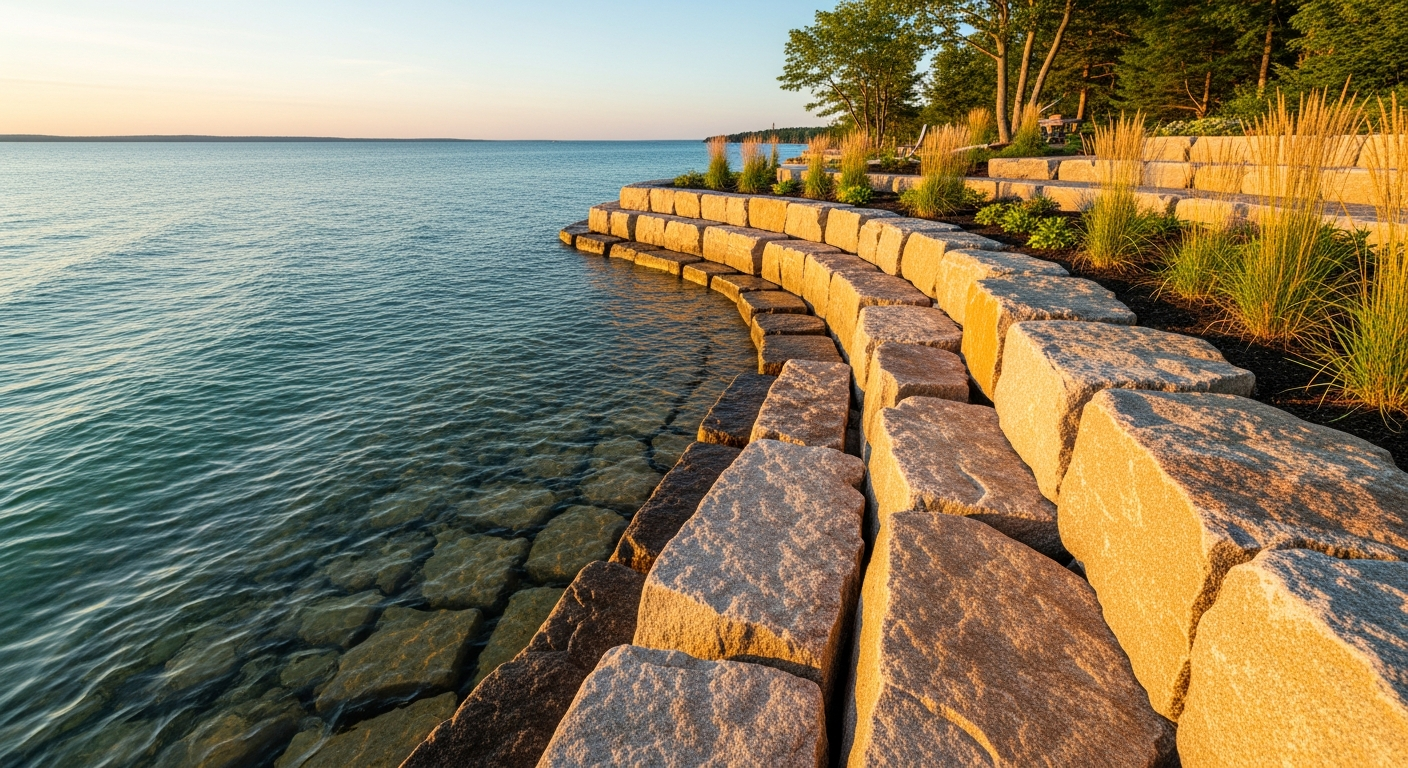
Georgian Bay water levels rise and fall over multi-year cycles, and high-water years bring wave erosion and soggy shoreline lots. A deep-rooted native buffer between the lawn and the water holds the bank and filters runoff, and stone at the waterline protects against waves. Shoreline work on Georgian Bay can need provincial and federal approvals, so plan it with a contractor who handles permits. Our guide to native shoreline plants for Georgian Bay covers planting.
Advanced Landscaping Techniques
For properties with higher flood risks, larger measures such as retention ponds, constructed wetlands and green roofs can add capacity. They help manage water flow and support wildlife, but ponds and wetlands near the shoreline can need municipal or provincial approval, so check before you dig.
Maintaining Your Landscape for Long-Term Effectiveness
The effectiveness of landscaping solutions in flood prevention is not only in their implementation but also in their maintenance. Regular checks, adjustments, and seasonal care are essential to ensure that your landscaping continues to protect your property against flooding. Each spring, clear leaves and sediment from swales, catch basins and drain outlets, top up soil where it has settled against the foundation, and check that downspout extensions are still attached.
Collaborating with Professionals and the Community
While many landscaping solutions can be implemented independently, collaborating with professional landscapers and leveraging community resources can enhance your flood management strategy. Professionals can offer insights into the most effective solutions for your property, while community collaboration can lead to more comprehensive flood prevention efforts.
Emergency Preparedness and Response
Even with the best landscaping solutions, it's important to be prepared for emergency situations. Creating a comprehensive emergency plan and keeping essential supplies on hand can help you and your family respond effectively in the event of a flood. If the cottage has a sump pump, test it before spring and consider a battery backup.
Recovery Tips Following a Flood Event
Should your property experience flooding, knowing how to assess landscape damage and engage professional restoration services is crucial for a swift and effective recovery.
Planning 2027 flood prevention landscaping for your cottage
The winter is the right time to plan drainage work for the 2027 season. Grading, swales and French drains all need thawed, dry ground, which around Midland usually arrives in late April or May, and drainage contractors fill their spring schedules early. Having a plan in hand means the work can start as soon as the ground allows, ideally before the wettest part of the year repeats.
Use this winter's snowmelt as your survey. Photograph where water collects and flows during the thaw, and mark the spots on a simple sketch of the property. Those notes, plus the location of the septic system and any shoreline work you want, are what a contractor needs to price the job.
- Fix grading first. It is usually the cheapest and most effective step.
- Plan every outlet. Each swale and drain needs somewhere legal to discharge.
- Check approvals for shoreline work. Georgian Bay shoreline projects can need permits that take time.
- Keep water off the septic bed. Route all drainage around it.
Frequently asked questions
How much should the ground slope away from a cottage?
At least 2% on lawn and planted areas and at least 1% on hard surfaces, which are the Town of Midland's lot grading minimums. A 2% slope is a 2 cm drop for every metre.
Do French drains work on clay soil?
Yes, as long as the drain has continuous fall to a real outlet. Clay drains slowly, so the drain mainly collects water that perches on top of the clay and carries it away.
Where should a rain garden go?
Downslope of the cottage, where roof or driveway runoff can reach it, and away from the foundation, the well and the septic bed. It should drain within a day or two after rain.
Do I need a permit for drainage work near Georgian Bay?
Grading on your own lot usually does not need one, but work at the shoreline or in the water can need provincial approval and review by Fisheries and Oceans Canada. Check with your municipality before you start.
Conclusion
Through strategic landscaping, cottage owners in Midland, Ontario, can effectively mitigate the risk of flooding while enhancing the beauty of their properties. By assessing risks, implementing and maintaining targeted landscaping solutions, and preparing for emergencies, you can protect your cottage from heavy rain, spring melt and rising water levels for years to come.
Planning a project this season?
We’ll walk the site, scope it properly and give you a straight price.
Forty-Five Scapes did an amazing job on my property. I started with such a mess, mud and weeds and poor grading. I met with Mark and he put my mind at ease. He took my wants and needs and budget and created a vision. The crew was always on time and respectful and the end product was amazing. I look forward to many years with my amazing outdoor space.
Frequently asked questions